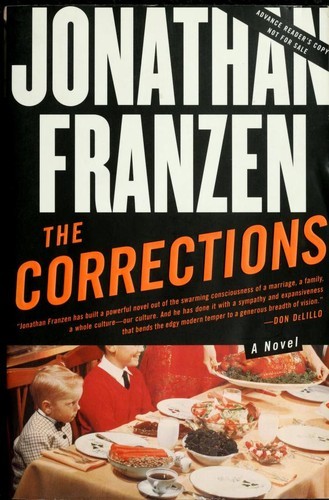
The Corrections
Jonathan Franzen (2001)
“A Midwestern family unravels across a continent, each member fleeing the same house and arriving at the same emptiness.”
The Corrections— Summary & Analysis
by Jonathan Franzen · published 2001 · 568 pages · Contemporary Literary Fiction
A user-friendly study guide for The Corrections by Jonathan Franzen (2001): a high-level plot summary, full chapter-by-chapter analysis, theme breakdowns, character profiles, and 30 essay questions designed for ap-english, college readers. Unlike a stock summary, sumsumsum.com adds a diction analysis drawn from Jonathan Franzen’s actual text, the 3 documented AP Literature exam appearances of this book, and reading-difficulty guidance (Moderate, 4/10) so students, teachers, and lifelong readers know what they are walking into.
“A Midwestern family unravels across a continent, each member fleeing the same house and arriving at the same emptiness.”
Short Summary
Alfred and Enid Lambert are aging in their St. Jude home — he declining with Parkinson's and dementia, she desperate for one last Christmas with all three adult children. Gary, a Philadelphia banker, fights depression and his wife's campaign to declare him clinically unwell. Chip, a fired academic, flees to Lithuania to help a fraudster build a website for a corrupt government. Denise, a brilliant chef, loses her restaurant job after affairs with both her employer and his wife. All three children return for Christmas, but the reunion only confirms that the family cannot be corrected. Alfred enters a nursing home. Enid begins, tentatively, to live for herself.
Detailed Summary
The Corrections follows the Lambert family of St. Jude, a fictional Midwestern city, as each member confronts private failures against the backdrop of late-1990s American excess. Alfred Lambert, a retired railroad engineer, is losing his mind to Parkinson's disease and an unspecified dementia. His w...
Summary in the Author’s Writing Style
A retelling of The Corrections in Jonathan Franzen’s style — so you can hear the language, not just the plot. This is a stylistic pastiche written by sumsumsum, not an excerpt from the book.
The madness of an autumnal high pressure system gripped the city of St. Jude, and in the house on Aspenwald Drive an old man sat in his blue chair in the basement, conducting an argument with a turd that was not there, while upstairs his wife Enid, who had spent forty years learning the exact shape …
Chapter-by-Chapter Analysis
If you liked The Corrections, read next
Start with The Great Gatsby by F. Scott Fitzgerald — The foundational American Dream autopsy — where Gatsby critiques the dream's promise, The Corrections critiques what happens to the families who believed it and built their lives accordingly. Then try A Visit from the Goon Squad by Jennifer Egan — Another multi-perspective American novel about time's corrections — Egan's formal experimentation and Franzen's realist ambition are opposite approaches to the same question: how time changes us. Or pivot to The Amazing Adventures of Kavalier & Clay by Michael Chabon — Published the same year, the other great American novel of 2000-2001 — where Franzen chose the family, Chabon chose friendship and art as structures for understanding American identity.
For comparative essays, pair The Corrections with
The strongest comparative pairing is American Pastoral (Philip Roth) — Another novel about the American Dream failing inside a family — Roth's Swede Levov is Alfred Lambert's East Coast mirror, a man undone by forces his competence cannot contain. For a third angle, contrast with White Noise (Don DeLillo) — DeLillo's academic satire and consumer-culture critique prefigure Chip Lambert's storyline — both novels anatomize the American family drowning in information and products.
Each of these pairings opens a clean thesis path on shared themes, period diction, or formal influence — useful for AP Lit / IB / first-year college comparative essays.