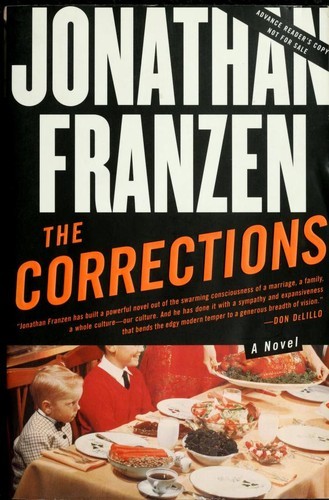
The Corrections
Jonathan Franzen (2001)
“A Midwestern family unravels across a continent, each member fleeing the same house and arriving at the same emptiness.”
Language Register
High literary register with sustained satirical undertone — Latinate vocabulary, complex syntax, punctuated by devastating colloquial deflation
Syntax Profile
Franzen writes long, accumulative sentences that build through subordinate clauses, parenthetical insertions, and appositive phrases — the syntax of a mind trying to account for everything simultaneously. Average sentence length exceeds 25 words in expository passages. Dialogue is shorter, clipped, evasive — the Lamberts speak in the negative space of what they refuse to say. The gap between the narrator's comprehensive syntax and the characters' reticent speech is the novel's central formal tension.
Figurative Language
Moderate — Franzen prefers extended metaphor and structural analogy over local figuration. The dominant metaphors (correction, generation, consumption) are conceptual rather than imagistic. When Franzen does deploy figurative language, it tends toward the clinical: bodies as machines, minds as systems, families as economies.
Era-Specific Language
Stock market crash, behavioral discipline, life-course adjustment — the word accumulates meanings throughout the novel
Pharmaceutical capitalism promising neurological miracles — the commodification of hope
Alfred's railroad — real American infrastructure dismantled by financial speculation
Post-structuralist jargon in Chip's sections — academic language as self-delusion
The fictional Midwest city — patron saint of lost causes, the name itself a judgment
How Characters Speak — Class & Identity
Alfred Lambert
Terse, declarative, emotionally withholding. Engineers' language: precise, functional, stripped of ornament. Speaks in imperatives at the dinner table.
Midwestern working-class masculinity elevated to management: competence as identity, silence as authority, emotional expression as weakness.
Enid Lambert
Relentlessly positive surface vocabulary — 'nice,' 'pleasant,' 'lovely' — masking anxiety, disappointment, and suppressed rage. Speaks in questions and suggestions rather than statements.
The Midwestern housewife's dialect: desire expressed as propriety, ambition disguised as cheerfulness, control exercised through apparent deference.
Gary Lambert
Corporate-therapeutic hybrid — investment banking vocabulary applied to family dynamics. Speaks of 'leverage,' 'exposure,' 'risk.' Uses clinical terms to avoid emotional ones.
The professionalization of the self: Gary has internalized the language of his class so completely that he cannot discuss his own depression without framing it as a portfolio problem.
Chip Lambert
Academic jargon layered over insecurity — post-structuralist vocabulary deployed to intellectualize personal failure. Code-switches between theory-speak and vulgar desperation.
The humanities PhD as class performance: Chip uses critical theory the way Gatsby uses 'old sport' — as linguistic camouflage for origins he is trying to transcend.
Denise Lambert
Professional kitchen language — precise, technical, commanding — alternating with a warmer, more physically present register in intimate scenes. Least verbal Lambert in family settings.
Competence as deflection. Denise speaks most fluently through actions (cooking, managing, fixing) and is most inarticulate about her own desires. The family's emotional labor falls to her because she performs it best.
Narrator's Voice
Third-person omniscient with sustained free indirect discourse — the narrator slides between characters' consciousnesses, adopting their vocabulary, their preoccupations, their blind spots. The effect is a novel that has no single perspective but rather a family of perspectives, each complete and each insufficient. Franzen's narrator is never neutral: the omniscience carries a satirical edge that softens into compassion as the novel progresses.
Tone Progression
St. Jude / The Failure
Satirical, diagnostic, comic
Franzen establishes the family's dysfunction with clinical precision and dark humor. The prose is at its most digressive and intellectually aggressive.
The More He Thought / At Sea
Claustrophobic, anxious, surreal
The humor darkens. Alfred's hallucinations push the prose toward grotesque surrealism. Gary's paranoia tightens the sentences. The novel's satirical distance begins to collapse.
The Generator / One Last Christmas
Tender, devastating, polyphonic
Denise's chapter introduces genuine emotional warmth. The Christmas reunion strips away irony. The prose becomes more direct as the family converges.
The Corrections
Quiet, earned, compassionate
The maximalism yields. The final chapter is the novel's simplest and most moving — Franzen trusts the accumulated weight of the narrative to carry meaning without satirical apparatus.
Stylistic Comparisons
- Don DeLillo — shared interest in American systems and corporate language, but Franzen is warmer, more invested in character
- Philip Roth — similar family-as-battlefield dynamics, but Franzen distributes focus across the family rather than centering on one consciousness
- John Updike — suburban domestic realism, but Franzen's scope is wider and his satire more systematic
- David Foster Wallace — maximalist contemporaries, but Franzen prioritizes plot and character over formal experimentation
Key Vocabulary from This Book
Notable words used in this text — click to see full definitions