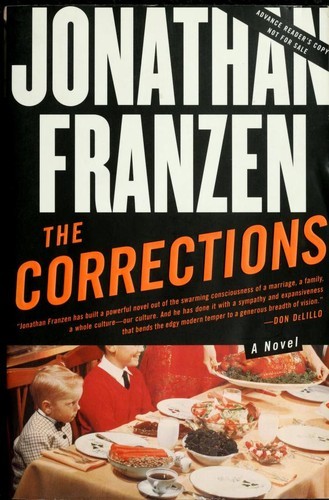
The Corrections
Jonathan Franzen (2001)
“A Midwestern family unravels across a continent, each member fleeing the same house and arriving at the same emptiness.”
Essay Questions & Food for Thought
30questions designed to challenge assumptions and provoke original thinking. These can't be answered from a summary — you need the actual text.
Why does Franzen title the novel 'The Corrections' rather than 'The Correction'? What does the plural form imply about the novel's argument — that there is not one reckoning but many, ongoing, and never final?
Each Lambert child's section reads as a different literary genre — Chip as academic satire, Gary as suburban psychological realism, Denise as food-and-desire narrative. Why does Franzen assign each child a different genre, and what does this formal choice reveal about how family position shapes identity?
Alfred's Parkinson's disease systematically destroys every form of control he ever exercised. Is Franzen using the disease purely as a medical reality, or is it also functioning as a metaphor for something happening to American patriarchal authority more broadly?
The novel's most surreal passages — Alfred's hallucinated talking turd, the cruise ship episodes — break sharply from Franzen's otherwise realist mode. Why does Franzen abandon realism precisely when depicting Alfred's interior experience?
Enid Lambert is arguably the novel's true protagonist, yet she is the character most consistently underestimated — by her family, by the reader, and by the narrative voice itself. When does Franzen's treatment of Enid shift from satirical to compassionate, and why?
Chip Lambert teaches a course on 'Consuming Narratives' — the critique of consumer culture — and then proves himself entirely subject to the forces he critiques. Is Franzen arguing that intellectual analysis of capitalism is futile, or something more nuanced?
Gary photographs himself smiling to prove he is not depressed. What does this act reveal about the relationship between performance and mental health in the novel — and in contemporary American life?
Denise's affairs with both Brian and Robin Passafaro resist simple explanation. Is she drawn to Robin, to Brian, to the destruction of their marriage, or to the destruction of her own career? Can these motivations be separated?
The fictional drug Aslan shares its name with the lion in C.S. Lewis's Narnia — a Christ figure who offers resurrection. Why does Franzen name the drug Aslan, and what does the allusion tell us about the novel's treatment of hope, salvation, and pharmaceutical promises?
Alfred refuses to profit from insider knowledge about the Midland Pacific's sale — a decision that costs the family enormously. Is this act moral integrity or another form of patriarchal control? Does the novel want us to admire Alfred or resent him?
The novel is set in the late 1990s, during the dot-com bubble. How does Franzen use the financial 'correction' as a structural parallel to the family's emotional reckoning? Where do the economic and personal plots intersect?
Franzen's free indirect discourse shifts between characters within single scenes, adopting each person's vocabulary and blind spots. Choose one scene and trace how the narrative voice changes as it moves between Lambert perspectives. What does each character fail to see?
St. Jude is the patron saint of lost causes. Why does Franzen name the Lambert hometown St. Jude? Is the family a lost cause, or does the novel ultimately argue otherwise?
Compare The Corrections to Death of a Salesman. Both depict American fathers whose self-constructed identities are collapsing, and families organized around the father's delusion. How are Alfred Lambert and Willy Loman similar and different?
The novel was published on September 1, 2001 — ten days before 9/11. How does knowing this timing affect your reading? Is The Corrections the last portrait of pre-terror American complacency, or does it already contain the anxieties that 9/11 made visible?
Franzen has said that his father's Alzheimer's was the autobiographical engine of the novel. How does knowing this affect your reading of Alfred's hallucination scenes — particularly the surreal episodes that border on magical realism?
Caroline, Gary's wife, never appears in a section narrated from her own perspective. We see her only through Gary's increasingly unreliable point of view. Is Caroline manipulative, or is Gary's perception of her manipulation itself a symptom of his depression?
Food is central to the novel — from Alfred's tyrannical dinner table to Denise's restaurant to the cruise ship menus to the Christmas dinner. How does Franzen use food as a vehicle for exploring power, desire, class, and family?
Chip's Lithuanian adventure is the novel's most explicitly picaresque and farcical section. Why does Franzen send Chip to post-Soviet Eastern Europe? What does Lithuania represent as a setting, and how does it mirror or contrast with St. Jude?
The novel ends with Enid rather than with any of the children. Why is this the right ending? What does it mean that the character treated most satirically for most of the novel gets the most emotionally generous final chapter?
How does The Corrections compare to Franzen's later novel Freedom (2010) in its treatment of the American family? Does Franzen's vision of the family change, or does he tell essentially the same story with different characters?
Franzen's Oprah controversy raised questions about literary elitism and popular culture. Does the novel itself take a position on this debate? Is The Corrections a populist or an elitist novel?
Alfred's railroad — the Midland Pacific — is dismantled by the same financial forces (leveraged buyouts, asset stripping) that characterize 1990s capitalism. How does Franzen connect the railroad's fate to Alfred's bodily deterioration?
The Corrections has been criticized for condescending to its Midwestern characters. Is this criticism fair? Does Franzen look down on St. Jude and its values, or does he treat them with genuine ambivalence?
Denise's teenage encounter with Don Armour is presented without the clear framing of either trauma or agency. Why does Franzen refuse to resolve this ambiguity? What does the refusal say about the novel's approach to sexuality and power?
The cruise ship is named the Gunnar Myrdal — after the Swedish economist who wrote 'An American Dilemma' about race in America. Why does Franzen name the ship after him, and what does the allusion suggest about the Lambert cruise?
Compare how Franzen and David Foster Wallace approach the American family. Wallace's work (particularly Infinite Jest) treats the family as a site of addiction and entertainment; Franzen treats it as a site of suppression and performance. Which diagnosis is more persuasive?
Why does Franzen give Enid the novel's final correction rather than any of the children? What does it mean that the most conservative, most Midwestern, most 'uncorrected' Lambert is the one who actually changes?
The novel's opening sentence — 'The madness of an autumn prairie cold front coming through' — establishes weather as metaphor. Trace how Franzen uses seasonal and atmospheric imagery throughout the novel. Does the family move from autumn toward winter, or toward spring?
If you were writing The Corrections in 2026, what would change? What would the 'correction' be now — climate collapse, political polarization, algorithmic media, fentanyl? Would the Lambert family structure still work as a diagnostic tool for American dysfunction?