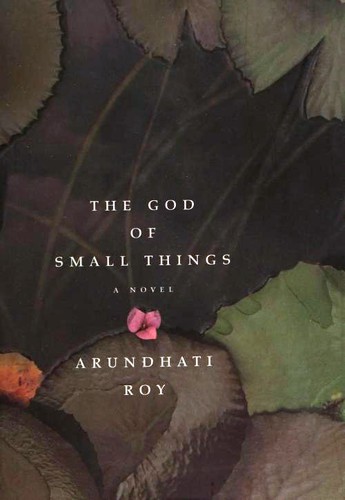
The God of Small Things
Arundhati Roy (1997)
“A family in Kerala is destroyed by the one law that matters most to the world around them: that some people are too small to be loved.”
This page prints on a single page. Use Ctrl+P / Cmd+P.
The God of Small Things
Arundhati Roy (1997) · 340pages · Contemporary / Postcolonial · 7 AP appearances
Summary
In 1969 Kerala, India, twin siblings Rahel and Estha watch their family destroyed by caste, politics, and the arrival of their half-English cousin Sophie Mol. Their mother Ammu's forbidden love for Velutha, an Untouchable carpenter, ends in his murder by police and the twins' lifelong scarring. The novel is told in fragments, circling the one night everything broke — a night revealed fully only at the end.
Why It Matters
The God of Small Things became the fastest-selling debut novel in UK publishing history when it was released. It won the Booker Prize in 1997, making Roy the first Indian woman and one of the youngest authors to win. It introduced a generation of Western readers to postcolonial Indian fiction bey...
Themes & Motifs
Diction & Style
Register: Formally literary with sustained childlike registers — Malayalam-inflected syntax, invented compound words, deliberate capitalization of concepts
Narrator: Roy uses a third-person narrator who has intimate access to the twins' interior lives but describes the adult world w...
Figurative Language: Extremely high, but unusually physical
Historical Context
Post-Independence India, 1960s Kerala — Communist governance, caste reform, postcolonial transition: Kerala in 1969 is simultaneously the most politically progressive state in India (Communist government, high literacy rates, strong labor movements) and a place where the caste system operates with...
Key Characters
Talking Points
- Roy ends the novel not with 1993 but with the last night of Ammu and Velutha's affair — ending on the word 'Tomorrow.' Why does she choose to end in the past rather than the present? What does this structural choice argue about memory and love?
- The novel's title refers to Velutha as 'the God of Small Things.' What are the small things in this novel? How does Roy distinguish them from the large things — History, the Love Laws, caste? Is being the god of small things a dignity or a diminishment?
- Roy uses capitalization for concepts rather than proper nouns — Love Laws, History, Silence, Returned. Choose three of these capitalized words and analyze what the capitalization does to them. Why is this a stylistic choice rather than a grammatical error?
- Baby Kochamma is not simply evil — she is empty, and Roy traces her emptiness to a specific unfulfilled love. How does Roy use Baby Kochamma to argue that thwarted desire is more dangerous than malice?
- Roy describes Kerala's Communist Party as an institution that claimed to liberate Untouchables while ultimately enforcing the hierarchy it promised to destroy. How does Comrade Pillai embody this contradiction? Is the novel's critique of the Left as sharp as its critique of the Right?
Notable Quotes
“They all broke the Love Laws. That lay down who should be loved. And how. And how much.”
“Estha had been Returned. Like a faulty product.”
“He was a Paravan. He had no business loving a woman who wasn't his to love.”
Why Read This
Because it does things with language that most novels don't attempt — not for decoration but because the story requires it. The twins' compound-word grammar, the capitalized Laws, the non-linear structure that makes you hold multiple time periods ...