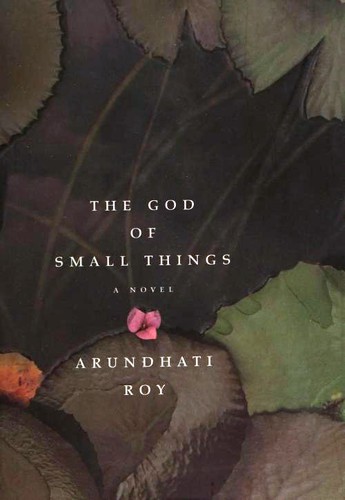
The God of Small Things
Arundhati Roy (1997)
“A family in Kerala is destroyed by the one law that matters most to the world around them: that some people are too small to be loved.”
The God of Small Things— Summary & Analysis
by Arundhati Roy · published 1997 · 340 pages · Contemporary / Postcolonial
A user-friendly study guide for The God of Small Things by Arundhati Roy (1997): a high-level plot summary, full chapter-by-chapter analysis, theme breakdowns, character profiles, and 30 essay questions designed for ap-english, college, ib readers. Unlike a stock summary, sumsumsum.com adds a diction analysis drawn from Arundhati Roy’s actual text, the 7 documented AP Literature exam appearances of this book, and reading-difficulty guidance (Easy, 3/10) so students, teachers, and lifelong readers know what they are walking into.
“A family in Kerala is destroyed by the one law that matters most to the world around them: that some people are too small to be loved.”
Short Summary
In 1969 Kerala, India, twin siblings Rahel and Estha watch their family destroyed by caste, politics, and the arrival of their half-English cousin Sophie Mol. Their mother Ammu's forbidden love for Velutha, an Untouchable carpenter, ends in his murder by police and the twins' lifelong scarring. The novel is told in fragments, circling the one night everything broke — a night revealed fully only at the end.
Detailed Summary
The God of Small Things unfolds in Ayemenem, a small town in Kerala, India, across two time periods: 1969, when the tragedy occurs, and 1993, when the adult Rahel returns to find her twin brother Estha in a state of silent collapse. The narrative weaves between these two periods in non-linear fragme...
Summary in the Author’s Writing Style
A retelling of The God of Small Things in Arundhati Roy’s style — so you can hear the language, not just the plot. This is a stylistic pastiche written by sumsumsum, not an excerpt from the book.
In Ayemenem the air was thick with the smell of pickle and the slow green river, and Time, when it broke, broke quietly, the way a thing breaks when nobody is looking at it directly. Years later, when Rahel came back, the house still smelled of the same dust, and her brother Estha sat inside his sil…
Chapter-by-Chapter Analysis
If you liked The God of Small Things, read next
Start with Midnight's Children by Salman Rushdie — Postcolonial India as subject, political allegory in family narrative — but Roy is more intimate, less pyrotechnic, more directly engaged with caste. Then try A Fine Balance by Rohinton Mistry — Caste, political violence, and survival in post-Independence India — Mistry is darker and more linear where Roy is lyrical and structural. Or pivot to The Kite Runner by Khaled Hosseini — Childhood trauma, class and social hierarchy, the impossibility of undoing a formative act of cowardice — a more melodramatic version of Roy's core moral problem.
For comparative essays, pair The God of Small Things with
The strongest comparative pairing is Beloved (Toni Morrison) — Non-linear trauma narrative, love destroyed by social hierarchy, the past that will not stay in the past — the closest structural and thematic parallel in world literature. Another productive pairing is One Hundred Years of Solitude (Gabriel García Márquez) — Family saga across generations, political history embedded in domestic life, non-linear time — but García Márquez mythologizes where Roy insists on the physical and political. For a third angle, contrast with The Remains of the Day (Kazuo Ishiguro) — Love suppressed by social hierarchy until it is too late, retrospective narration from a position of loss — structurally different but thematically a close match.
Each of these pairings opens a clean thesis path on shared themes, period diction, or formal influence — useful for AP Lit / IB / first-year college comparative essays.