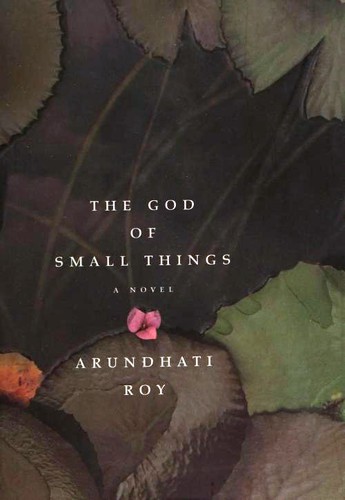
The God of Small Things
Arundhati Roy (1997)
“A family in Kerala is destroyed by the one law that matters most to the world around them: that some people are too small to be loved.”
Essay Questions & Food for Thought
30questions designed to challenge assumptions and provoke original thinking. These can't be answered from a summary — you need the actual text.
Roy ends the novel not with 1993 but with the last night of Ammu and Velutha's affair — ending on the word 'Tomorrow.' Why does she choose to end in the past rather than the present? What does this structural choice argue about memory and love?
The novel's title refers to Velutha as 'the God of Small Things.' What are the small things in this novel? How does Roy distinguish them from the large things — History, the Love Laws, caste? Is being the god of small things a dignity or a diminishment?
Roy uses capitalization for concepts rather than proper nouns — Love Laws, History, Silence, Returned. Choose three of these capitalized words and analyze what the capitalization does to them. Why is this a stylistic choice rather than a grammatical error?
Baby Kochamma is not simply evil — she is empty, and Roy traces her emptiness to a specific unfulfilled love. How does Roy use Baby Kochamma to argue that thwarted desire is more dangerous than malice?
Roy describes Kerala's Communist Party as an institution that claimed to liberate Untouchables while ultimately enforcing the hierarchy it promised to destroy. How does Comrade Pillai embody this contradiction? Is the novel's critique of the Left as sharp as its critique of the Right?
The Ammu-Velutha sex scene was the stated grounds for the obscenity prosecution in India. Roy has said the real offense was the caste transgression, not the sex. How does the novel itself support this reading — what makes the relationship transgressive in the world Roy depicts?
Estha's Silence lasts twenty-three years. Roy does not attribute it to a single cause but traces it through multiple traumas — the Orangedrink Lemondrink Man, the nod in the police cell, the separation from Rahel. What does this accumulative model of trauma argue about how damage works?
Roy's compound words — 'KolapettyGreenLeafFan,' 'OrEngland' — are presented without explanation. What do they do to the reader's experience of the twins' consciousness? Why does Roy refuse to explain them?
The novel's structure withholds Sophie Mol's drowning — the central plot event — and shows it only in the gap between scenes. Why does Roy refuse to describe it directly? What is gained by this ellipsis?
Chacko explains to the twins that they are 'a family of Anglophiles — pointed in the wrong direction, trapped outside our own history.' Is Chacko right? Does the novel agree with his diagnosis, complicate it, or refute it through action?
Roy is a political activist as well as a novelist. How does The God of Small Things differ from a political pamphlet? What does fiction do that argument alone cannot?
The History House is an abandoned colonial planter's bungalow that has been converted into a hotel by 1993. What does this transformation represent? How does the novel use physical spaces to contain and transmit historical meaning?
Compare Roy's treatment of caste with Morrison's treatment of race in Beloved. Both novels deal with love that is destroyed by social hierarchy. How do the two novelists' formal choices — structure, narration, language — reflect the specific histories they are describing?
Ammu says to the twins, in a moment of rage, that they are 'millstones around her neck.' She immediately regrets it. The twins carry the words for the rest of their lives. What does the novel argue about the permanence of language and the impossibility of taking back what is spoken?
Roy writes that the Love Laws dictate 'who should be loved, and how. And how much.' The third element — 'how much' — is easy to miss. What does it mean to legislate the quantity of love? Find evidence in the novel for love that is policed not just in kind but in degree.
Roy uses the Malayalam terms 'Kochamma,' 'Pappachi,' 'Chacko' without translation throughout the novel. What effect does this have on a reader who doesn't know Malayalam? Is this an act of exclusion, an act of respect, or something else?
How would the novel change if it were told in strict chronological order? What specific emotional and thematic effects depend on the non-linear structure?
Vellya Paapen, Velutha's father, reports his son's relationship with Ammu to Mammachi. He is a Paravan who has internalized the rules that oppress him enough to enforce them against his own son. How does the novel treat this figure? With judgment, sympathy, or something more complex?
Roy has not published a second novel. She has instead published political essays and become an activist. What does the novel itself suggest about the relationship between political writing and fiction? Is The God of Small Things itself a political act?
The twins are described as having a 'single, ectoplasmic inhabitation' — they share a consciousness in a way that ordinary siblings do not. How does Roy represent this in the novel's language? And what does their eventual separation do to this shared consciousness?
Roy describes Velutha's beating with forensic precision — naming each injury, each officer. Why does she choose clinical language for the most emotional scene in the novel? What would be lost if she had written it lyrically?
The novel's 1993 present-day is marked by the decay of the family home and the corruption of the Communist Party. Roy suggests that political hope and domestic life have both degraded in the decades since 1969. Is the novel pessimistic about the possibility of change? Or does it locate hope somewhere smaller?
Sophie Mol's whiteness — her half-Englishness — grants her a social status in the Ipe family that the twins do not have. How does Roy trace the specific mechanism by which colonial hierarchy operates within a family — not as ideology but as daily practice?
Ammu's death happens offscreen — mentioned in the novel's early chapters as a fact already established. Roy never depicts it. Why does she deny Ammu a death scene?
The God of Small Things is set in 1969 and written in 1997. Its author has said she heard the language before she knew the story. What does this suggest about the relationship between form and content in the novel? Does the language feel like it came first?
Compare Ammu and Hester Prynne from The Scarlet Letter. Both women commit sexual transgressions that their societies punish with exile and social death. How do Roy and Hawthorne treat their heroines differently? What does the difference reveal about their political intentions?
Roy's description of Kerala — the backwaters, the monsoon, the rubber trees — is physically beautiful even as it frames terrible events. How does she use landscape in the novel? Is the beauty of the setting in tension with the ugliness of what happens there, or does the tension itself become an argument?
How does the novel treat the complicity of institutions — the police, the Communist Party, the family, the Church — in Velutha's death? Is any institution innocent? Does Roy leave space for institutional redemption?
The twins' reunion in 1993 ends in an incestuous encounter. Roy renders this without condemnation. How do you read this scene — as psychological realism (two people shattered by the same event seeking the only comfort left), as symbolism, or as a final transgression of the Love Laws? Does it matter which reading is correct?
The God of Small Things won the Booker Prize and made Roy famous, but she has said she wrote it for herself — that it was a private act of witness to a particular Kerala and a particular kind of damage. How does knowing this change your understanding of the novel's audience? Does literature written for yourself read differently than literature written for readers?