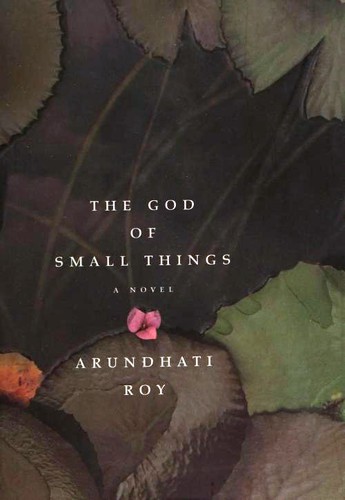
The God of Small Things
Arundhati Roy (1997)
“A family in Kerala is destroyed by the one law that matters most to the world around them: that some people are too small to be loved.”
The God of Small Things— Historical Context & Author Background
Author: Arundhati Roy · Published 1997· Era: Contemporary / Postcolonial·340 pages
Themes explored: caste, love, family, loss, politics, memory, transgression, childhood
About Arundhati Roy
Arundhati Roy (born 1961) grew up in Ayemenem, Kerala — the novel's setting is autobiographical. Her parents' marriage was a transgression of its own kind: a Hindu Bengali man and a Syrian Christian woman from Kerala. She trained as an architect, worked in films, and wrote The God of Small Things in her mid-thirties. It won the Booker Prize in 1997, making her the first Indian woman to win. She has not published a second novel since — she became instead a political essayist and activist, writing about nuclear testing, dam construction, and Kashmir. The novel was prosecuted in India for obscenity; the prosecution was ultimately dismissed. Roy has said the book took four years to write and that the language came first — she heard the voices before she knew the plot.
Life → Text Connections
How Arundhati Roy's real experiences shaped specific elements of The God of Small Things.
Roy grew up in Ayemenem with a Syrian Christian mother who had divorced her first husband — a social position of significant marginality in Kerala's religious communities
Ammu's position as a divorced woman returned to her family home, her children treated as collateral damage of her social fall
Ammu is drawn from life. Her isolation is not imagined but remembered.
Roy was trained as an architect and has described the novel's structure as architectural — built from fragments that only reveal their full shape at the end
The non-linear narrative structure, which withholds the central event and approaches it from every angle before revealing it fully
The structure is not an experiment — it is an argument about how trauma is experienced and remembered.
Roy became one of India's most prominent political activists after the novel's publication, writing about caste, environmental destruction, and political violence
The novel's engagement with caste, colonial legacy, and the Communist Party is not academic — it comes from a writer already committed to these politics
The God of Small Things is a political novel that disguises itself as a family tragedy. The politics precede the fiction.
The novel was prosecuted for obscenity in India — the sex between Ammu and Velutha was the stated grounds, but the caste transgression was the real target
The Love Laws — the novel's central concept — were immediately activated by the novel's own existence
The prosecution proved the novel's thesis: the world does, in fact, have laws about who may love whom.
Historical Era
Post-Independence India, 1960s Kerala — Communist governance, caste reform, postcolonial transition
How the Era Shapes the Book
Kerala in 1969 is simultaneously the most politically progressive state in India (Communist government, high literacy rates, strong labor movements) and a place where the caste system operates with brutal effectiveness in the daily lives of the very people the communists claim to represent. Roy's novel is set exactly in this gap: the gap between the constitutional abolition of untouchability and its persistence in social practice, between socialist rhetoric and caste hierarchy, between Independence and its incomplete fulfillment.
Why The God of Small Things Matters Historically
The God of Small Things became the fastest-selling debut novel in UK publishing history when it was released. It won the Booker Prize in 1997, making Roy the first Indian woman and one of the youngest authors to win. It introduced a generation of Western readers to postcolonial Indian fiction beyond the Rushdie-dominated mode, demonstrating that the political could be rendered through the intimate, the domestic, and the physical rather than through allegory and pyrotechnics. Its non-linear structure and its treatment of caste have made it a standard text in postcolonial studies, world literature, and feminist criticism.
- First Indian woman to win the Booker Prize
- One of the first novels to represent the Dalit experience from the perspective of its effect on a high-caste family — not from a Dalit narrator but from the people who participate in the destruction
- Pioneered a non-linear trauma narrative structure that was widely imitated in postcolonial fiction
Prosecuted in India for obscenity (the Ammu-Velutha sex scene); the prosecution was filed by a retired academic and eventually dismissed. Roy has said the real charge was not obscenity but the transgression of caste — the obscenity complaint was the available instrument for enforcing the Love Laws the novel describes.