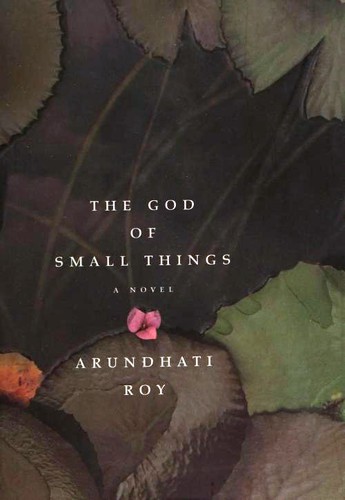
The God of Small Things
Arundhati Roy (1997)
“A family in Kerala is destroyed by the one law that matters most to the world around them: that some people are too small to be loved.”
Language Register
Formally literary with sustained childlike registers — Malayalam-inflected syntax, invented compound words, deliberate capitalization of concepts
Syntax Profile
Roy deploys three distinct syntactic registers simultaneously: the compound-word compressions of the twins' child consciousness (KolapettyGreenLeafFan, OrEngland); the long, rolling, sensory sentences of the love chapters; and the short, flat, declarative prose of the violence. The reader can orient themselves temporally by the syntax alone, before consulting tense markers.
Figurative Language
Extremely high, but unusually physical — Roy's metaphors insist on bodily reality rather than abstract beauty. She compares political and social abstractions to physical sensations. The Love Laws are described as having texture, weight, temperature. History has a smell.
Era-Specific Language
Caste designation for Untouchables in Kerala — Roy never translates it, forcing the reader to encounter it without the buffer of explanation
The caste distinction that organizes the novel's central tragedy — Roy capitalizes both, making them conditions rather than adjectives
Roy's bureaucratic euphemisms for the destruction of children — the passive voice performing the violence of the act
Malayalam honorific for an older woman — used for multiple female characters, creating a web of named but unnamed womanhood
The abandoned colonial planter's bungalow — Roy always capitalizes it, treating it as a proper noun for an improper history
How Characters Speak — Class & Identity
Velutha
Speaks with directness and warmth; Roy gives him no linguistic markers of deference in his thoughts, only in his speech to the family (where he uses honorifics). The gap between interior voice and performed voice is the measure of his dignity.
A man whose interior life is fully human and fully present, in a world that insists on treating him as less than that.
Ammu
Precise, controlled, occasionally bitter. Her speech is educated — Syrian Christian upper middle class — but her position is marginal. She knows the rules and refuses to perform them in private.
Education without social position. The capacity to see clearly without the power to act. Her voice is the novel's moral center.
Chacko
Oxford-educated, politically fluent, sexually careless. His language is the most formally Western in the novel — 'our Anglophilia,' 'the colonized mind' — deployed to explain problems he perpetuates.
The postcolonial intellectual who can analyze his own complicity without escaping it. His politics are correct; his behavior is not.
Baby Kochamma
Sweet in public performance, precise in private surveillance. Her speech is social performance; her silence is calculation. Roy gives her no lyrical moments.
The danger of thwarted desire curdled into vigilance. She has no interior life that Roy grants us access to — only what she watches.
Rahel and Estha (as children)
Private compound language, precise sensory observation, refusal of adult abstraction. They experience the world in color and texture before meaning.
Roy's argument that children's consciousness is a superior moral instrument — it sees accurately before categories corrupt vision.
Narrator's Voice
Roy uses a third-person narrator who has intimate access to the twins' interior lives but describes the adult world with increasing irony and rage. The narrator is not neutral: she tells us what History did and what it costs. The retrospective position means that beauty and doom coexist in every sentence.
Tone Progression
Chapters 1-4
Elegiac-anticipatory
The world before and after the catastrophe simultaneously — Roy shows us the decay of 1993 and the life of 1969 in alternating fragments. The tone is already grieving.
Chapters 5-10
Sensory-political
The texture of 1969 life — family, food, politics, love developing. Roy's prose is warmest here, but always haunted by the retrospective knowledge of the narrator.
Chapters 11-16
Dread-clinical
The approach and arrival of the catastrophe. Roy's prose strips down. The lyricism disappears. Short sentences, flat grammar, the administrative processing of people's destruction.
Chapters 17-21
Witness-lyrical
The survivors, the site, and finally the recovered past. Roy's final chapter returns to full lyricism — the last night, fully warm, the word 'Tomorrow' opening rather than closing.
Stylistic Comparisons
- Toni Morrison's Beloved — non-linear trauma narrative, the past refusing to stay in the past, love and its destruction by historical violence
- Gabriel García Márquez's One Hundred Years of Solitude — similarly non-linear, similarly concerned with family and history, but Roy's politics are less mythic and more specific
- Salman Rushdie's Midnight's Children — postcolonial India, political allegory embedded in family narrative, but Roy is more intimate and less pyrotechnic
Key Vocabulary from This Book
Notable words used in this text — click to see full definitions