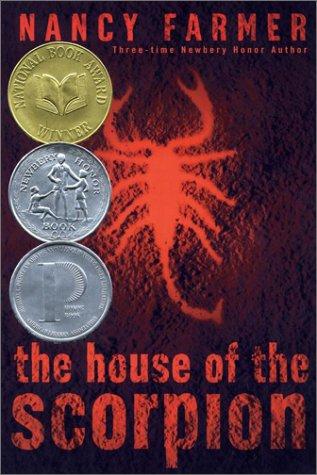
The House of the Scorpion
Nancy Farmer (2002)
“A boy discovers he is a clone — property, not a person — and must prove his humanity in a world that denies it.”
This page prints on a single page. Use Ctrl+P / Cmd+P.
The House of the Scorpion
Nancy Farmer (2002) · 380pages · Contemporary / Young Adult Dystopia · 1 AP appearances
Summary
Matt is a clone of El Patrn, the 140-year-old drug lord who rules Opium, a narco-state wedged between the United States and Mexico. Raised in secret by the cook Celia and educated by his bodyguard Tam Lin, Matt grows up in a household that treats him as either a pet or a monster. When he discovers his true purpose — to serve as an organ harvest for El Patrn — he escapes across the border into Aztln (formerly Mexico), survives the brutal labor camps of the Keepers, and ultimately returns to inherit Opium after El Patrn's death, positioned to dismantle the empire built on eejit slavery and human trafficking.
Why It Matters
Won the National Book Award for Young People's Literature (2002) and received both a Newbery Honor and a Michael L. Printz Honor — one of very few novels to receive all three major youth literature recognitions. The novel demonstrated that young adult fiction could engage with cloning ethics, imm...
Themes & Motifs
Diction & Style
Register: Clear, concrete prose accessible to younger readers but layered with political allegory and moral complexity beneath the surface
Narrator: Third-person limited through Matt's consciousness. The narration is technically external but emotionally intimate — w...
Figurative Language: Moderate
Historical Context
Published 2002 — post-9/11 America, intensified border security debates, cloning ethics after Dolly the sheep (1996): The novel arrived at the intersection of two cultural anxieties: cloning technology (Dolly the sheep had made it real) and immigration enforcement (the U.S.-Mexico border was becoming increasingly ...
Key Characters
Talking Points
- Matt shares every gene with El Patrn, yet the novel argues they are fundamentally different people. What specific experiences and relationships make Matt who he is rather than a copy of his original? Is the novel's argument about nature versus nurture convincing?
- Why does Farmer choose to have most clones in Opium lobotomized at birth? What does it say about the society that they need to destroy clone consciousness to maintain the system?
- The eejits are immigrants who were captured at the border and surgically converted into compliant labor. How does this parallel historical systems of slavery? Where does the parallel break down, and where is it uncomfortably exact?
- Tam Lin is a former terrorist who killed twenty children. Does his sacrifice at the end of the novel redeem him? Can a single act of love erase a history of violence?
- Celia saves Matt by slowly poisoning him with foxglove. Is this an act of love, an act of deception, or both? What does it say about resistance that the only way to save Matt was to make him medically worthless to his owner?
Why Read This
Because the question at the center of this novel — what makes someone a person? — is the question that matters most in an age of artificial intelligence, genetic engineering, and immigration debates. Matt's struggle to be recognized as human is no...