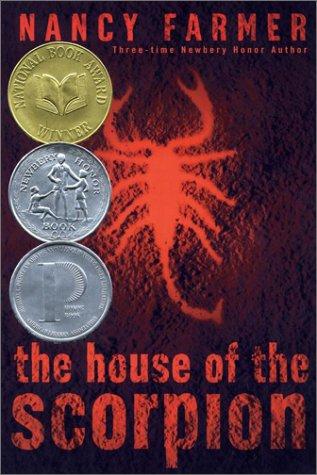
The House of the Scorpion
Nancy Farmer (2002)
“A boy discovers he is a clone — property, not a person — and must prove his humanity in a world that denies it.”
Why This Book Matters
Won the National Book Award for Young People's Literature (2002) and received both a Newbery Honor and a Michael L. Printz Honor — one of very few novels to receive all three major youth literature recognitions. The novel demonstrated that young adult fiction could engage with cloning ethics, immigration politics, and slavery without condescending to its audience, opening the door for the wave of sophisticated YA dystopia that followed (The Hunger Games, Divergent, The Maze Runner).
Firsts & Innovations
One of the first YA novels to treat cloning as a serious ethical question rather than a science fiction gimmick
Pioneered the integration of immigration politics into dystopian world-building for young readers
Among the earliest YA novels to draw explicit parallels between futuristic technology and historical slavery
Demonstrated that middle-school readers could engage with morally complex, politically specific narratives
Cultural Impact
Taught widely in middle and high school English and ethics classes across the United States
Credited as an influence on the YA dystopian wave of 2008-2015 (Hunger Games, Divergent, The Maze Runner)
Frequently cited in bioethics curricula as an accessible introduction to cloning and personhood debates
Sequel The Lord of Opium (2013) continued the narrative but the original stands as the defining work
Used in immigration studies and social justice curricula to prompt discussion of border politics and labor exploitation
Banned & Challenged
Occasionally challenged in schools for violence, the depiction of drug production, and themes considered inappropriate for younger readers. Some challenges have cited the novel's treatment of cloning as conflicting with religious views on the sanctity of human creation. Ironically, the novel's core argument — that every conscious being deserves recognition as a person — is deeply compatible with religious ethics.