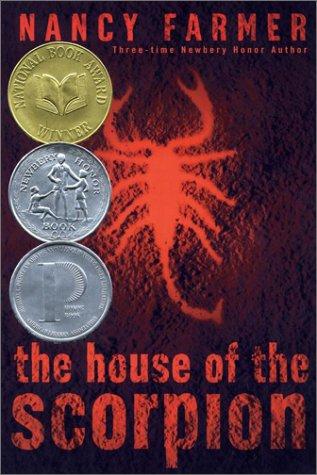
The House of the Scorpion
Nancy Farmer (2002)
“A boy discovers he is a clone — property, not a person — and must prove his humanity in a world that denies it.”
The House of the Scorpion— Historical Context & Author Background
Author: Nancy Farmer · Published 2002· Era: Contemporary / Young Adult Dystopia·380 pages
Themes explored: identity, cloning-ethics, immigration, slavery, power, humanity, free-will
About Nancy Farmer
Nancy Farmer (born 1941) spent years living in Africa — Mozambique, Zimbabwe, and South Africa — where she worked as an entomologist and witnessed political systems built on labor exploitation, racial hierarchy, and border enforcement. She later lived along the U.S.-Mexico border in Arizona, where immigration politics and the drug trade were daily realities. These experiences inform every element of Opium's world-building: the eejit labor system draws from African colonial labor practices, the border politics draw from her Arizona observations, and the Keepers draw from her knowledge of revolutionary movements that promised equality and delivered oppression.
Life → Text Connections
How Nancy Farmer's real experiences shaped specific elements of The House of the Scorpion.
Farmer lived in Mozambique during the civil war and witnessed forced labor under both colonial and revolutionary governments
The eejit system — human beings surgically converted into compliant labor units
Farmer did not invent the eejit system from imagination. She observed real systems that reduced people to labor units and translated them into science fiction terms.
Living on the Arizona-Mexico border, Farmer saw the human cost of immigration enforcement firsthand
Opium as a buffer state that captures immigrants and converts them to eejits
The novel's border politics are not abstract allegory. They are a direct amplification of policies Farmer watched destroy real families.
As an entomologist, Farmer studied organisms scientifically — categorizing, classifying, observing behavior in controlled environments
Matt's creation in a laboratory, his classification as 'property,' the clinical language of the cloning process
Farmer's scientific training gives the novel its unsettling clinical precision. She knows how institutions classify living things, and she applies that knowledge to human beings.
Farmer witnessed post-colonial revolutionary governments in Africa that used idealistic rhetoric to justify authoritarian control
The Keepers' communal ideology masking forced child labor
The Keepers are not a cartoon villainy. They are drawn from Farmer's observation of real political movements that corrupted their own ideals.
Historical Era
Published 2002 — post-9/11 America, intensified border security debates, cloning ethics after Dolly the sheep (1996)
How the Era Shapes the Book
The novel arrived at the intersection of two cultural anxieties: cloning technology (Dolly the sheep had made it real) and immigration enforcement (the U.S.-Mexico border was becoming increasingly militarized). Farmer synthesized these anxieties into a single narrative by asking: what happens when a border state has access to cloning technology and an unlimited supply of undocumented human beings? The answer is Opium — a world that felt like science fiction in 2002 and reads increasingly like political commentary with each passing year.
Why The House of the Scorpion Matters Historically
Won the National Book Award for Young People's Literature (2002) and received both a Newbery Honor and a Michael L. Printz Honor — one of very few novels to receive all three major youth literature recognitions. The novel demonstrated that young adult fiction could engage with cloning ethics, immigration politics, and slavery without condescending to its audience, opening the door for the wave of sophisticated YA dystopia that followed (The Hunger Games, Divergent, The Maze Runner).
- One of the first YA novels to treat cloning as a serious ethical question rather than a science fiction gimmick
- Pioneered the integration of immigration politics into dystopian world-building for young readers
- Among the earliest YA novels to draw explicit parallels between futuristic technology and historical slavery
- Demonstrated that middle-school readers could engage with morally complex, politically specific narratives
Occasionally challenged in schools for violence, the depiction of drug production, and themes considered inappropriate for younger readers. Some challenges have cited the novel's treatment of cloning as conflicting with religious views on the sanctity of human creation. Ironically, the novel's core argument — that every conscious being deserves recognition as a person — is deeply compatible with religious ethics.