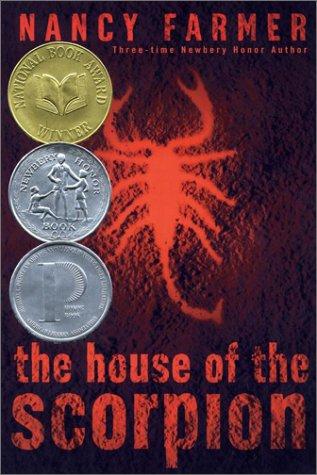
The House of the Scorpion
Nancy Farmer (2002)
“A boy discovers he is a clone — property, not a person — and must prove his humanity in a world that denies it.”
The House of the Scorpion— Summary & Analysis
by Nancy Farmer · published 2002 · 380 pages · Contemporary / Young Adult Dystopia
A user-friendly study guide for The House of the Scorpion by Nancy Farmer (2002): a high-level plot summary, full chapter-by-chapter analysis, theme breakdowns, character profiles, and 30 essay questions designed for middle-school, high-school readers. Unlike a stock summary, sumsumsum.com adds a diction analysis drawn from Nancy Farmer’s actual text, the 1 documented AP Literature exam appearance of this book, and reading-difficulty guidance (Easy, 2/10) so students, teachers, and lifelong readers know what they are walking into.
“A boy discovers he is a clone — property, not a person — and must prove his humanity in a world that denies it.”
Short Summary
Matt is a clone of El Patrn, the 140-year-old drug lord who rules Opium, a narco-state wedged between the United States and Mexico. Raised in secret by the cook Celia and educated by his bodyguard Tam Lin, Matt grows up in a household that treats him as either a pet or a monster. When he discovers his true purpose — to serve as an organ harvest for El Patrn — he escapes across the border into Aztln (formerly Mexico), survives the brutal labor camps of the Keepers, and ultimately returns to inherit Opium after El Patrn's death, positioned to dismantle the empire built on eejit slavery and human trafficking.
Detailed Summary
In a future where a strip of land called Opium separates the United States from Aztln (Mexico), the drug lord Matteo Alacrn — known as El Patrn — has ruled for nearly 150 years by growing opium poppies with a labor force of eejits: human beings with computer chips implanted in their brains that dest...
Summary in the Author’s Writing Style
A retelling of The House of the Scorpion in Nancy Farmer’s style — so you can hear the language, not just the plot. This is a stylistic pastiche written by sumsumsum, not an excerpt from the book.
In the beginning there were thirty-six of them, floating in their cells like seeds in a pod, and Matt was the only one allowed to grow. He did not know this. He knew the little house in the poppy fields, and Celia, who smelled of garlic and onions and cooking, and who told him he was the most import…
If you liked The House of the Scorpion, read next
Start with The Giver by Lois Lowry — Dystopia accessible to young readers with a protagonist who discovers the truth about his society and must choose between safety and freedom. Or pivot to Brave New World by Aldous Huxley — Engineered humans in a rigidly stratified society — Huxley's Epsilons are Farmer's eejits, conditioned rather than implanted but equally unfree.
For comparative essays, pair The House of the Scorpion with
The strongest comparative pairing is Never Let Me Go (Kazuo Ishiguro) — Clones raised for organ harvest — but Ishiguro's characters accept their fate with English politeness while Matt fights with everything he has. Another productive pairing is Animal Farm (George Orwell) — The Keepers' rhetoric of equality masking exploitation directly echoes Orwell's pigs — 'all animals are equal, but some are more equal than others'. For a third angle, contrast with The Hunger Games (Suzanne Collins) — YA dystopia that followed Farmer's path — young protagonist discovering the machinery of oppression and choosing to fight rather than submit.
Each of these pairings opens a clean thesis path on shared themes, period diction, or formal influence — useful for AP Lit / IB / first-year college comparative essays.