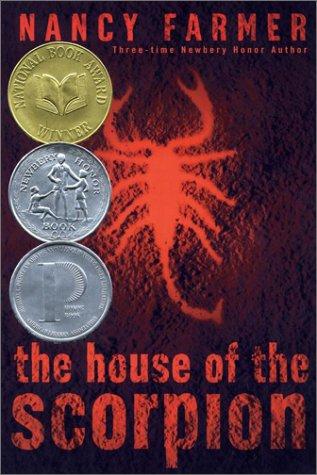
The House of the Scorpion
Nancy Farmer (2002)
“A boy discovers he is a clone — property, not a person — and must prove his humanity in a world that denies it.”
Language Register
Clear, concrete prose accessible to younger readers but layered with political allegory and moral complexity beneath the surface
Syntax Profile
Short-to-medium sentences averaging 12-15 words, reflecting both the young adult audience and Matt's developing consciousness. Syntax grows more complex as Matt matures — early chapters use simple subject-verb-object constructions, while later chapters introduce subordinate clauses and abstract vocabulary. Dialogue is sharply differentiated by character.
Figurative Language
Moderate — Farmer favors concrete imagery over extended metaphor. The world-building itself IS the figurative language: eejits are the metaphor for slavery, Opium is the metaphor for border politics, Matt is the metaphor for what makes someone human. The novel's power comes from its literal events carrying allegorical weight without breaking the surface of realism.
Era-Specific Language
Human being with brain implant destroying free will — derived from Scottish/Irish slang for 'idiot,' repurposed as a term of institutional dehumanization
The narco-state between the U.S. and Aztln — named for the crop that funds it, the name itself normalizes the drug trade
Future Mexico, named after the Aztec mythological homeland — signals cultural reclamation
Opium's border enforcement — captures immigrants and converts them to eejits
Legally defined as property, not person — the single word carries the novel's entire ethical argument
How Characters Speak — Class & Identity
Matt
Evolves from a child's simple observations to increasingly analytical, morally engaged narration. His vocabulary expands as his world does.
Consciousness as a function of education and experience. Matt's language proves his humanity more convincingly than any argument.
El Patrn
Formal, nostalgic, storytelling cadence. Long sentences that circle back to his childhood. Speaks about himself in the third person when telling origin stories.
A man who has rehearsed his own mythology for 140 years. The formality is control; the nostalgia is self-justification.
Tam Lin
Blunt, idiomatic, Scottish-inflected. Uses folk wisdom and proverbs. Speaks in short declarative sentences with moral force.
Working-class intellectual who has read widely but never lost his origins. His language is unpretentious and trustworthy — the opposite of El Patrn's rehearsed grandeur.
Mara
Earnest, morally certain, sometimes sermonic. Speaks with the directness of a child raised on clear ethical principles.
Privilege that produces conscience rather than cruelty. Mara's certainty is both her strength and her limitation.
The Keepers
Ideological jargon — 'collective good,' 'community standards,' 'equal contribution.' Abstract language that obscures concrete exploitation.
Totalitarian rhetoric. The gap between the Keepers' language and their actions IS the critique.
Narrator's Voice
Third-person limited through Matt's consciousness. The narration is technically external but emotionally intimate — we see only what Matt sees and understand only what Matt understands. As Matt's understanding grows, the narration grows with it, creating a coming-of-age effect embedded in the point of view itself.
Tone Progression
Chapters 1-8
Innocent, confined, increasingly disturbing
Matt's world is small and controlled. The prose is simple and domestic, but details accumulate that signal something deeply wrong.
Chapters 9-18
Revelatory, urgent, terrifying
The machinery of Opium becomes visible. The prose accelerates. Political and personal stakes converge.
Chapters 19-28
Harsh, resilient, defiant
The Keeper chapters are bleak and physical. The prose strips down to survival basics. Matt's voice hardens.
Chapters 29-38
Reflective, burdened, cautiously hopeful
Matt gains knowledge and responsibility simultaneously. The prose matures into political and philosophical engagement.
Stylistic Comparisons
- Kazuo Ishiguro's Never Let Me Go — clones raised for organ harvest, but Ishiguro's characters accept their fate; Matt fights his
- Lois Lowry's The Giver — dystopia accessible to young readers, but Farmer's world is more politically specific
- George Orwell's Animal Farm — ideological language masking exploitation, directly echoed in the Keeper chapters
- Margaret Atwood's The Handmaid's Tale — bodily autonomy denied by the state, but scaled for a younger audience
Key Vocabulary from This Book
Notable words used in this text — click to see full definitions