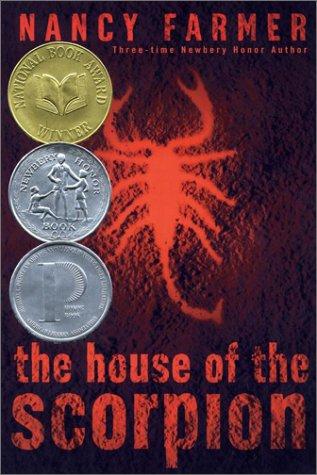
The House of the Scorpion
Nancy Farmer (2002)
“A boy discovers he is a clone — property, not a person — and must prove his humanity in a world that denies it.”
Essay Questions & Food for Thought
30questions designed to challenge assumptions and provoke original thinking. These can't be answered from a summary — you need the actual text.
Matt shares every gene with El Patrn, yet the novel argues they are fundamentally different people. What specific experiences and relationships make Matt who he is rather than a copy of his original? Is the novel's argument about nature versus nurture convincing?
Why does Farmer choose to have most clones in Opium lobotomized at birth? What does it say about the society that they need to destroy clone consciousness to maintain the system?
The eejits are immigrants who were captured at the border and surgically converted into compliant labor. How does this parallel historical systems of slavery? Where does the parallel break down, and where is it uncomfortably exact?
Tam Lin is a former terrorist who killed twenty children. Does his sacrifice at the end of the novel redeem him? Can a single act of love erase a history of violence?
Celia saves Matt by slowly poisoning him with foxglove. Is this an act of love, an act of deception, or both? What does it say about resistance that the only way to save Matt was to make him medically worthless to his owner?
The Keepers use the language of equality and community to run forced-labor camps. How does their ideological rhetoric compare to the explicit hierarchy of Opium? Which system is more honest about what it is?
Mara insists from the beginning that Matt has a soul. Is her certainty a strength or a limitation? Does the novel ultimately prove her right, and if so, what constitutes the 'proof'?
El Patrn's childhood stories about his dead siblings are genuinely tragic. How does Farmer prevent the reader from sympathizing with El Patrn? Or does she intentionally allow sympathy — and if so, why?
Compare the eejit system to modern debates about artificial intelligence and consciousness. If an AI could think and feel, would the arguments used to deny clone personhood apply? How does the novel help us think about non-human consciousness?
Farmer sets the novel in a future where Mexico has become 'Aztln.' What does the name change signify politically and culturally? Why does Farmer choose to rename the country?
The novel won the National Book Award and received a Newbery Honor — the highest recognitions in children's literature. What does it mean that a novel about cloning, drug trafficking, and slavery was considered appropriate for young readers? Should it be?
Matt's escape route through the desert parallels the journeys of real immigrants crossing the U.S.-Mexico border. How does Farmer use Matt's privileged background (Big House education, Tam Lin's training) to both enable his survival and highlight the vulnerability of those without such advantages?
Why does El Patrn's will require the death of his entire household? What does this final act reveal about how he viewed the people around him?
Compare The House of the Scorpion to Kazuo Ishiguro's Never Let Me Go. Both novels feature clones raised for organ harvest. Why does Matt fight his fate while Ishiguro's characters accept theirs? What does each novel's approach reveal about its view of human agency?
The novel contains no scene where a scientist, philosopher, or authority figure definitively proves that Matt is a person. Why does Farmer omit this? Is the absence of proof itself the point?
Ton-Ton is mocked for his stutter and assumed to be unintelligent. How does his character challenge the same assumptions about worth and capacity that define Matt's struggle as a clone?
Opium exists because both the United States and Aztln find it politically convenient. How does the novel's treatment of international complicity apply to real-world situations where powerful nations tolerate human rights abuses for strategic reasons?
Matt inherits Opium at the end of the novel but has no blueprint for dismantling it. Why does Farmer end the story at the beginning of the hardest work rather than showing the revolution completed?
Rosa's treatment of Matt — locking him in sawdust, feeding him on the floor — mirrors historical practices used to dehumanize enslaved people. Why does Farmer include this scene, and what does Rosa's cruelty reveal about how ordinary people participate in systems of oppression?
The novel uses the word 'property' as both a legal term and a moral weapon. Trace every instance where Matt is called property, a thing, or an 'it.' How does the language used to describe Matt shape how others treat him?
Farmer is an entomologist by training — a scientist who studies insects. How does her scientific background appear in the novel's approach to cloning, the clinical language of the laboratory scenes, and the systematic classification of beings as 'property'?
If you were Matt, and you returned to Opium as its ruler, what would be your first three actions? Use evidence from the novel to explain why these actions would be most urgent.
The novel presents two models of family: the biological (El Patrn's DNA) and the chosen (Celia, Tam Lin, Mara). Which does the novel value more, and how does it demonstrate this preference?
The Keepers strip children of their names and assign numbers. The eejits have their brains altered to remove volition. In what ways are these two forms of identity destruction similar? In what ways is one worse than the other?
El Patrn's story mirrors the classic 'rags to riches' American Dream narrative — a poor boy who built an empire through sheer will. How does the novel critique the American Dream by making its most successful practitioner a drug lord and slave owner?
Why is the novel called The House of the Scorpion? What does the scorpion symbolize, and how does the title connect to the themes of poison, survival, and self-destruction?
Mara's mother Esperanza is a senator who opposes Opium but has not been able to dismantle it. What does the novel suggest about the limits of political activism when facing entrenched systems of power?
The novel was published in 2002, the same year as the first human cloning claims (later debunked). How does knowing the historical context of the cloning debate change your reading of the novel's ethical arguments?
Matt organizes the orphans not through violence or dramatic heroism but through small acts of humanization — using names, sharing food, telling stories. Why does Farmer choose this model of leadership? What does it argue about how change actually happens?
At the end of the novel, Matt is genetically identical to El Patrn, legally his heir, and about to inherit his empire. The novel insists he will use this power differently. Is this optimism earned, or is it a comforting fiction? What evidence from the text supports your answer?