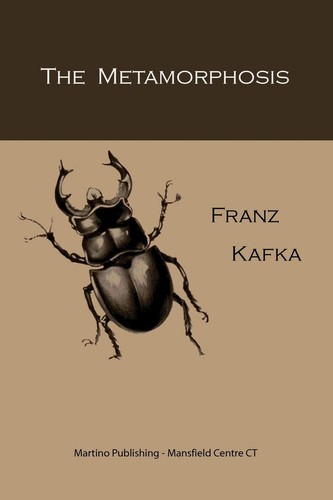
The Metamorphosis
Franz Kafka (1915)
“A man wakes up as a giant insect. His family's horror reveals a truth about being human that no realistic story could: we are only as human as the people around us choose to see us.”
The Metamorphosis— Historical Context & Author Background
Author: Franz Kafka · Published 1915· Era: Modernist / Expressionist·55 pages
Themes explored: alienation, family, identity, dehumanization, duty, isolation, transformation
About Franz Kafka
Franz Kafka (1883–1924) was born in Prague to a German-speaking Jewish merchant family. His father, Hermann Kafka, was a domineering, self-made businessman who regarded his son's literary ambitions with contempt. Kafka worked for years as a claims assessor at the Workers' Accident Insurance Institute — a bureaucratic job he was good at and found dehumanizing. He wrote in the early morning hours before work. He published very little in his lifetime and instructed his friend Max Brod to burn all his manuscripts after his death. Brod refused. Without that refusal, The Metamorphosis would not exist. Kafka died of tuberculosis at forty, having contracted the disease that would kill him around the time he completed this novella.
Life → Text Connections
How Franz Kafka's real experiences shaped specific elements of The Metamorphosis.
Kafka's relationship with his father Hermann — documented in his 45-page 'Letter to His Father' (1919), never delivered — was the defining wound of his life. Hermann was physically imposing, commercially successful, and dismissive of his son's sensitivity and writing.
Gregor's father is the novella's most physically threatening presence. He stamps, hisses, and eventually wounds his son with a thrown apple. He does not attempt to understand what he sees. His reinvigoration when Gregor falls is the novella's most autobiographical element.
The Metamorphosis can be read as the 'Letter to His Father' rewritten as fable. Kafka could not say directly: 'you made me feel like vermin.' He could write a story in which a son literally becomes vermin, and let the reader do the rest.
Kafka worked at the Workers' Accident Insurance Institute, processing the claims of injured workers — people literally damaged by industrial labor, whose suffering had to be translated into bureaucratic categories.
The novella's prose style is the prose of the insurance office: flat, precise, categorical. Gregor's transformation is described with the same affect one would use to describe a workplace injury.
The form IS the argument. Kafka wrote about alienated labor in the language of the institution that managed alienated labor's casualties. The style is not incidental — it is the meaning.
Kafka was engaged three times and never married. His relationship with Felice Bauer, conducted almost entirely through letters, was marked by his terror of the obligations of domestic life — the sense that marriage would consume his writing time, his freedom, his self.
Gregor's financial obligation to his family — the debt that chains him to his job — mirrors Kafka's felt obligation to his family and fiancées. Both trap their subject in a role that precludes authentic selfhood.
The insect transformation enacts Kafka's fantasy and nightmare: what if I simply could not do what they need from me? What would happen? The novella is the answer, and the answer is not comforting.
Kafka instructed Max Brod to destroy all his unpublished work after his death — letters, diaries, novels. He called his own work 'scribblings.' Brod refused and published everything.
Gregor dies wishing to disappear, believing his death is the best gift he can give his family. The wish to be erased — to remove oneself from the burden of being — is the novella's emotional core.
Kafka himself wanted his work destroyed. The Metamorphosis, the novella about a creature who is erased by those who love him, was written by a man who wanted to erase himself. The parallel is too precise to be coincidental.
Historical Era
Early 20th century — Habsburg Empire, industrial modernity, the bureaucratic state
How the Era Shapes the Book
The Habsburg bureaucratic culture provided both the novella's setting (the unnamed firm, the office manager, the debt) and its prose style. The early 20th century transformation of the European family — from agricultural unit to wage-earning nuclear household — made Gregor's role as sole breadwinner both typical and precarious. When the machine breaks down, the family has no fallback. The modernity that created Gregor's job also created his trap.
Why The Metamorphosis Matters Historically
Published in 1915 in a German literary journal, then as a book by Kurt Wolff Verlag. Kafka lived to see it in print but not to see its significance recognized. After Brod's posthumous publication of Kafka's novels (The Trial, The Castle) in the 1920s, The Metamorphosis was retroactively recognized as the key to Kafka's entire project. It is now the most widely taught German-language literary text in the world and has given the English language an adjective: 'Kafkaesque.'
- Established the template for literary absurdism: the fantastic premise treated as banal, never explained
- One of the first works to embed bureaucratic language as a literary style — form as argument
- Pioneered the focalized-limited third-person narration transferred at death — a technique later used by Faulkner and Woolf
Banned and burned by the Nazis as 'degenerate literature' (entartete Kunst) because Kafka was Jewish. Also suppressed in the Soviet Union for much of the 20th century — Soviet literary doctrine required fiction to affirm labor and the collective; Kafka's worker becomes vermin, and his family is relieved. The ban was lifted only after Stalin's death.