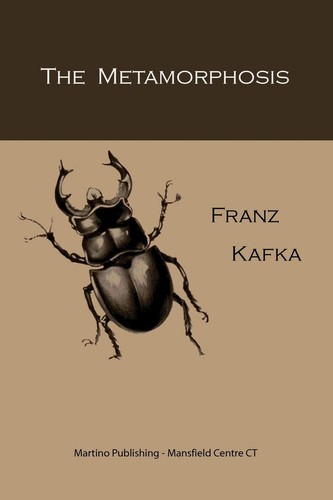
The Metamorphosis
Franz Kafka (1915)
“A man wakes up as a giant insect. His family's horror reveals a truth about being human that no realistic story could: we are only as human as the people around us choose to see us.”
Essay Questions & Food for Thought
30questions designed to challenge assumptions and provoke original thinking. These can't be answered from a summary — you need the actual text.
Kafka never names what kind of insect Gregor becomes. Why? What is the effect of leaving it unspecified, and what does it tell us about how Kafka wants us to read the transformation?
Gregor's first thoughts after discovering his transformation are about being late for his train. What does this tell us about the state he was in BEFORE the transformation?
The novella is often read as an allegory for labor alienation — the worker reduced to a function, then discarded. What is the textual evidence for this reading? What does it leave unexplained?
Grete begins the novella as Gregor's most devoted caretaker and ends as his executioner. Trace her transformation. Is she a villain by the end?
The father's reinvigoration — his new job, his uniform he won't take off — happens in direct proportion to Gregor's degradation. What is Kafka arguing about the structure of family and patriarchal authority?
Kafka's prose style is called 'bureaucratic' or 'flat.' Choose three sentences and analyze how the style creates the horror rather than describing it.
Gregor can understand everything his family says, but they do not know this. How does this gap between Gregor's comprehension and his family's assumption drive the tragedy?
Nabokov argued that Gregor has wings — mentioned once in Part II — but never uses them. Is this a flaw in Gregor's character, a symbolic choice, or simply a detail Kafka forgot? What would it mean if Gregor had flown away?
The apple that lodges in Gregor's back is never removed. Analyze this as a symbol. What does it represent, and what is the significance of its remaining?
Is the mother's silence at the final family council — when Grete delivers the verdict — more or less damning than the father's 'Thanks be to God'?
Kafka's novella has been read as: (a) an allegory for labor alienation, (b) an allegory for the Jewish experience of assimilation, (c) an allegory for Kafka's relationship with his father, (d) a study of illness and family caregiving. Which reading do you find most textually supported? Can more than one be simultaneously true?
Compare Gregor's death to the ending of a Greek tragedy. Does he have a hamartia (fatal flaw)? Is his death cathartic or merely grim?
The novella ends with the parents noticing that Grete has grown into a 'pretty girl with a good figure.' Why does Kafka end here? What is the effect of this final image?
In his 'Letter to His Father,' Kafka wrote that his father made him feel he was 'always in your highest court.' How does this language help explain the dynamic between Gregor and the father in the novella?
Kafka asked his friend Max Brod to destroy all his manuscripts. Brod refused. If Brod had obeyed — if this novella had been burned — what would be lost from world literature?
Gregor dies thinking of his family 'with tenderness and love.' He accepts the verdict that he must disappear. Is this an act of love or an act of psychological defeat? Does Kafka intend us to admire Gregor or pity him?
The three lodgers are treated with respect and deference by the family — offered the best food, the best furniture, careful service. How does this treatment contrast with Gregor's, and what is Kafka saying about the relationship between money and human dignity?
How would The Metamorphosis read differently if it were told from Grete's perspective? From the father's? From the mother's? What does Kafka's choice of Gregor's perspective cost us — and give us?
Gregor is drawn out of his room by Grete's violin playing. 'Was he an animal, that music had such an effect on him?' Kafka asks. How does this question function — is it rhetorical? Sincere? Ironic?
The cleaning woman is the only character who is not afraid of Gregor and not responsible for him. How does her treatment of him — casually cruel, practically efficient — differ morally from the family's treatment?
Compare Gregor Samsa to Josef K. in Kafka's The Trial. Both are prosecuted by systems they do not understand and cannot appeal. How are their responses to absurd accusation similar or different?
The novella opens in medias res — we arrive after the transformation has already happened. Why? What would be lost if Kafka had shown us the moment of transformation?
Research the history of 'Kafkaesque' as a word. What does it mean? Give three examples from contemporary life — workplace, technology, government — where the word applies accurately.
Kafka was a Czech Jew writing in German, living under Habsburg imperial rule, working in an insurance bureaucracy. How do each of these identities leave traces in The Metamorphosis?
Does The Metamorphosis have a moral? If so, what is it? If not, is the absence of a moral itself the moral?
Many readers report that The Metamorphosis is funny — darkly, absurdly comic. What is Kafka doing that creates this effect? Can something be simultaneously tragic and comedic?
If Gregor's transformation were literal — if he actually became a physical insect — and if you were Grete, what would you do differently? At what point, if any, is the family's response justified?
The Metamorphosis was published in 1915, the same year as the first use of chemical weapons in WWI. Does this historical context change your reading of the novella's themes of dehumanization and disposability?
Gregor never gets angry. He understands what is happening to him, he feels the injustice, and he does not rebel. Is his acceptance a character flaw, a cultural artifact, or the point of the novella?
The Metamorphosis was almost burned. It survived because Brod disobeyed. The novella is about someone who is erased. Write a paragraph about the irony of this biographical fact and what it means for how we read the text.