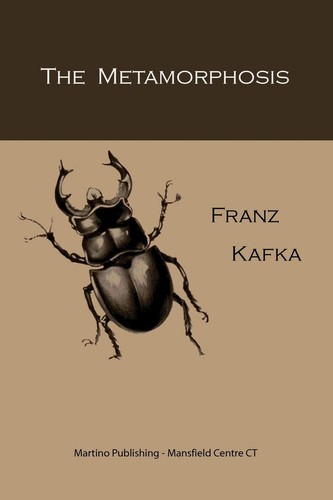
The Metamorphosis
Franz Kafka (1915)
“A man wakes up as a giant insect. His family's horror reveals a truth about being human that no realistic story could: we are only as human as the people around us choose to see us.”
Language Register
Deliberately flat, precise, matter-of-fact — the language of reports and receipts applied to the impossible
Syntax Profile
Kafka's sentences are long but not lyrical — they accumulate subordinate clauses the way bureaucratic documents do, building qualification upon qualification. The German syntax, in which verbs arrive at the sentence's end, is partially preserved in good translations, creating a sense of deferred arrival. The matter-of-fact tone is the primary stylistic choice: what is impossible is described as if it were unremarkable. This is the flatness that makes the horror land.
Figurative Language
Low — deliberately. Kafka uses almost no metaphor or simile in the traditional sense. The entire novella IS the metaphor; to add decorative figurative language inside it would collapse the effect. What looks like realism IS the figure of speech.
Era-Specific Language
A travelling salesman — a figure of modernity, rootlessness, and alienated labor
The anonymous, faceless employer — never named, always present, always surveilling
German original: 'monstrous vermin' — Kafka refused to specify the species; translators who say 'cockroach' are wrong
The office manager — his visit the morning of the transformation reveals how thoroughly Gregor's employer owns him
Kafka's most repeated phrase — the room is both Gregor's prison and his only remaining space of selfhood
How Characters Speak — Class & Identity
Gregor Samsa
Internal monologue is precise, loyal, and self-effacing. He thinks about schedules, debts, obligations. Even as an insect he uses the language of the dutiful employee. He never complains directly.
The middle-class worker who has so thoroughly internalized his role as provider that even his suffering is organized around usefulness. He does not rebel. He apologizes.
Grete
Begins with soft, tender language; ends with cold, formal disavowal. Her speech in Part III is the most legalistic in the novella — 'we must try to get rid of it,' 'I don't think anyone could reproach us.' She has adopted the language of institutional justification.
The transformation of love into resentment tracked through language. Grete does not become cruel — she becomes pragmatic. In Kafka's world, pragmatism IS cruelty.
The Father
Largely nonverbal — he hisses, stamps, pounds fists. When he does speak it is in short, decisive clauses. His bank messenger uniform gives him a borrowed authority he did not earn.
Patriarchal authority without moral content — the father wields power through aggression, not persuasion. His reinvigoration when Gregor falls mirrors how authoritarian structures require a subordinate to dominate.
The Mother
Gentle, hesitant, full of half-finished sentences and fainting spells. She cannot complete a thought about Gregor without collapsing. Her compassion is real but structurally powerless.
The limits of sympathy without agency. The mother feels for Gregor but cannot act — her social role within the family prevents intervention. Her silence in the final verdict is the most painful absence in the text.
The Manager (Office Chief Clerk)
Formal, corporate, instantly panicked. His speech through the door is the language of institutional threat dressed as concern.
The firm's relationship with its workers: surveillant, threatening, and ultimately indifferent to the human being behind the employee number. He runs not because Gregor is dangerous — but because the sight of him is inconvenient.
Narrator's Voice
Third-person limited, rigidly focalized on Gregor — except the final paragraphs, when Gregor dies and the focalization smoothly transfers to the family without comment. We are inside Gregor's consciousness throughout his life. When he dies, the narration simply moves on. This structural choice is the novella's final cruelty: the world does not stop when Gregor stops. The narration doesn't even pause.
Tone Progression
Part I
Anxious, dutiful, tragicomic
Gregor is embarrassed about being late. The prose is almost comic in its insistence on the mundane. Horror and farce are indistinguishable.
Part II
Melancholy, eroding, quietly desperate
The weeks accumulate. The small acts of love diminish. The apple is lodged. The prose lengthens and slows.
Part III
Resigned, cold, then strangely bright
Gregor's acceptance. Grete's disavowal. The family's relief. The final paragraph is almost cheerful — and the cheerfulness is the horror.
Stylistic Comparisons
- Gogol's The Nose — bureaucratic absurdism as a predecessor; Kafka is darker, less comic
- Camus's The Stranger — similar flat affect describing alienation, but Meursault chooses; Gregor doesn't
- Beckett's Waiting for Godot — shared suspension of resolution, but Beckett gives his characters language; Kafka takes it away
Key Vocabulary from This Book
Notable words used in this text — click to see full definitions