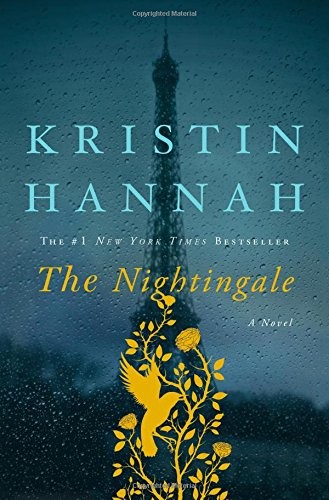
The Nightingale
Kristin Hannah (2015)
“Two sisters in Nazi-occupied France make impossible choices — and one of them will disappear from history entirely.”
Language Register
Conversational with lyrical moments — clear, direct prose with periodic emotional amplification
Syntax Profile
Hannah's sentences average 12–15 words — shorter than most literary fiction, longer than thrillers. She favors the simple declarative subject-verb-object pattern, which creates clarity and accessibility. Emotional peaks are signaled by sentence shortening: the most devastating moments often get the fewest words. This is a craft technique — brevity at the moment of impact forces the reader to supply the emotion rather than receiving it pre-packaged.
Figurative Language
Moderate — Hannah uses figurative language purposefully rather than prolifically. The nightingale as extended metaphor (singing in darkness, guiding through sound) runs throughout. Nature imagery (Loire Valley orchards, Pyrenees snow, German autumn) is used to mark the passage of time and the seasons of the war. Hannah avoids the dense metaphorical layering of literary fiction; her imagery is accessible and emotionally direct.
Era-Specific Language
French Resistance network — Hannah uses the French term to authenticate the setting
The Nazi practice of forcing French families to house German soldiers in their homes
French rural guerrilla Resistance fighters — distinct from urban networks
The compulsory Star of David Jews were forced to wear — Hannah uses it without explanation, trusting reader knowledge
Nazi concentration camp for women — Hannah never explains it, treating it as a proper noun readers must reckon with
How Characters Speak — Class & Identity
Vianne
Domestic, specific, grounded in physical objects — the garden, the kitchen, the school. Her language is about things she can touch.
A woman whose identity is built around home and continuity. The war violates the domestic sphere she has made her fortress.
Isabelle
Declarative, impulsive, frequently hyperbolic. She says things in their largest possible form. No hedging.
A young woman who has learned that soft speech gets you ignored. Her directness is armor.
Captain Beck
Formal, apologetic, carefully polite. His German syntax occasionally shows through in sentence structure.
A man performing decency within an indecent system. The politeness is real AND a performance.
Von Richter
Clipped, contemptuous, never explains himself. Commands rather than requests.
Power that feels no need to justify itself. The contrast with Beck measures the spectrum of collaboration.
Narrator's Voice
Dual third-person close POV, alternating between Vianne and Isabelle. The frame sections use first person (unnamed, later revealed as Vianne). Each sister's POV chapter has a distinct emotional register: Vianne's chapters are more cautious, observational, interior; Isabelle's are more kinetic and external. Hannah maintains this distinction consistently enough that readers can often sense which POV they're in from the first paragraph.
Tone Progression
Frame + Early Occupation
Quiet dread, ordinary life under pressure
Hannah establishes normalcy before shattering it. The Loire Valley feels real and fragile.
Resistance Chapters
Tense, purposeful, occasionally exhilarating
The Pyrenees crossings carry genuine momentum. Isabelle's chapters have thriller pacing.
Escalation and Capture
Dread, grief, exhausted endurance
The novel's emotional weight accumulates. Hannah's prose strips down as the stakes rise.
Liberation and Death
Bittersweet, muted, elegiac
Liberation without restoration. The prose is at its most restrained in the death scenes.
Frame Resolution
Quiet triumph, long-delayed recognition
The frame closes with an act of naming — grief transformed into testimony.
Stylistic Comparisons
- All the Light We Cannot See by Anthony Doerr — same era, more literary prose; Doerr maximizes language, Hannah maximizes emotion
- Sarah's Key by Tatiana de Rosnay — similar dual-timeline structure, French WWII setting, women's experience
- The Alice Network by Kate Quinn — similar female Resistance operative premise, comparable accessible-commercial register
Key Vocabulary from This Book
Notable words used in this text — click to see full definitions