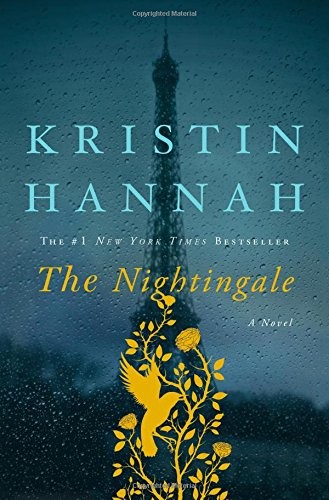
The Nightingale
Kristin Hannah (2015)
“Two sisters in Nazi-occupied France make impossible choices — and one of them will disappear from history entirely.”
Essay Questions & Food for Thought
30questions designed to challenge assumptions and provoke original thinking. These can't be answered from a summary — you need the actual text.
The novel uses a dual POV structure, alternating between Vianne and Isabelle. Whose story is more important to tell — the dramatic resistance operative's or the quiet hidden resister's? What would we lose if the novel focused only on Isabelle?
Hannah opens the novel in 1995 with an unnamed old woman, withholding her identity until the end. What does this structural choice do for the reader? How does knowing she is Vianne — not Isabelle — change your understanding of the whole story?
Captain Beck is courteous, shares rations, and warns Vianne before searches. Is he a good person? Does his decency excuse his role in the occupation? Can you be a decent person inside a criminal system?
'In love we find out who we want to be; in war we find out who we are.' Does the novel prove this claim? Are there moments where war reveals something unexpected — even positive — about a character?
Vianne's form of resistance — hiding children, forging papers — is invisible and deniable. Isabelle's is dramatic and visible. Which requires more courage? Does the novel take a position, or does it deliberately withhold judgment?
Hannah bases the Nightingale's work on the real historical Comet Line escape network, which was run largely by women. Why do you think this history was not widely taught before Hannah's novel? What does its obscurity say about how we record history?
Julien Rossignol was an absent, emotionally unavailable father who failed both daughters — and dies protecting Isabelle at the moment of her arrest. Is this redemption? Can one act undo decades of failure?
Von Richter rapes Vianne and she conceals the pregnancy, not knowing if the child is Antoine's or Von Richter's. Hannah never resolves this ambiguity. Why does she choose not to? What would be lost if she gave a definitive answer?
Compare Vianne at the beginning of the novel — cautious, domestic, conflict-avoidant — to Vianne at the end. What changed her? Was it the war itself, or specific events within the war? Identify three turning points.
The novel is titled after Isabelle's code name, but Vianne is the narrator and survivor. Why is it called The Nightingale and not something that reflects Vianne? What does this title choice argue about whose story matters?
Hannah depicts French civilians as both resisters AND collaborators — some French police actively aided Nazi deportations. How does the novel handle French complicity? Does it make excuses for it, condemn it, or just show it?
Isabelle says: 'I am not brave. I just know what I would regret.' What does this definition of courage mean? Is it different from the usual definition? Does the novel support or complicate it?
Hannah's novel shows that women were central to the French Resistance — as couriers, forgers, and operatives — yet these contributions were largely unrecorded. How is The Nightingale itself an act of historical recovery? What is Hannah arguing that historians should do differently?
Compare The Nightingale to a war novel with a male protagonist (All Quiet on the Western Front, The Things They Carried, Catch-22). What is different about how war is depicted when the main characters are women? What is the same?
Antoine returns from the German POW camp 'broken' — unable to fully rejoin family life. Vianne has also been broken and reassembled 'wrong.' Do they successfully rebuild their marriage? Does Hannah suggest they can? Should they?
The novel implies that Vianne hid her identity — as a Resistance figure, as a war survivor — for fifty years and told no one, not even her son. Why might a survivor choose that silence? What does silence protect, and what does it cost?
Hannah based Isabelle's Pyrenees crossings on the real Comet Line, run largely by a young Belgian woman named Andrée de Jongh. Research de Jongh. Where does Hannah stay close to historical fact, and where does she depart from it? Does it matter?
The novel's epigraph and opening lines argue that war reveals character. But Isabelle's character was already fixed — reckless, defiant — before the war. Did the war reveal who she was, or did it just give her the right circumstances to become who she already was?
At Isabelle's grave, Gaëtan appears but barely speaks. Hannah gives him almost nothing to say. Why? What does his near-silence communicate about grief, love, and what war does to relationships?
How does the relationship between Vianne and Isabelle change across the novel? Map three specific moments where their dynamic shifts. What is the final state of their relationship — resolved, complicated, or something else?
Hannah writes about the Holocaust from an American perspective, about French experiences, with German characters. What are the ethical obligations — and risks — of writing about trauma that is not your own? Does The Nightingale handle this responsibly?
The nightingale sings in darkness to guide travelers. How does this image apply to each major character? Who is the nightingale, and who are the travelers being guided? Does the metaphor hold for Vianne as well as Isabelle?
Hannah depicts the gradual normalization of persecution — yellow stars, then registration, then deportation — as something that happened incrementally. Why is the incremental quality important? What does it say about how atrocity happens and how ordinary people respond to it?
Compare Vianne hiding Jewish children to the Danish rescue of Danish Jews during the same war. Both involved ordinary people taking extraordinary risks. What made some populations resist and others collaborate? Does Hannah's novel suggest an answer?
The frame narrative takes place in 1995 — fifty years after the war. Why did Vianne wait fifty years to speak publicly? What made 1995 the right time? What might Hannah be saying about how long it takes for suppressed history to surface?
Hannah's prose is often described as emotionally direct — she names feelings explicitly rather than implying them. Compare this approach to a more restrained novelist (Hemingway, for example). What are the advantages and disadvantages of each approach for depicting wartime experience?
The novel implies that Vianne's son Julien may be the child of her rapist, Von Richter. If Julien knew this — and he doesn't — how might it change his identity? What does Vianne's silence on this question protect, and at what cost?
Hannah dedicates the novel to 'the women who were never given the right words.' What does it mean to be 'given the right words'? Who controls which words a historical narrative receives, and who decides which stories are worth the words?
The novel ends with Vianne saying her sister's name. Why is this act — simply naming Isabelle publicly — the novel's climax? What does naming someone do that a monument or a medal cannot?
The Nightingale has been criticized by some literary critics as too emotionally manipulative — engineered to produce crying rather than thinking. Do you agree? Can a novel be emotionally powerful AND intellectually serious at the same time, or do they trade off against each other?