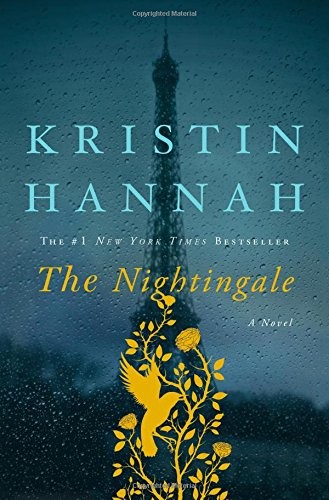
The Nightingale
Kristin Hannah (2015)
“Two sisters in Nazi-occupied France make impossible choices — and one of them will disappear from history entirely.”
The Nightingale— Summary & Analysis
by Kristin Hannah · published 2015 · 440 pages · Contemporary / Historical Fiction
A user-friendly study guide for The Nightingale by Kristin Hannah (2015): a high-level plot summary, full chapter-by-chapter analysis, theme breakdowns, character profiles, and 30 essay questions designed for high-school readers. Unlike a stock summary, sumsumsum.com adds a diction analysis drawn from Kristin Hannah’s actual text, and reading-difficulty guidance (Easy, 1/10) so students, teachers, and lifelong readers know what they are walking into.
“Two sisters in Nazi-occupied France make impossible choices — and one of them will disappear from history entirely.”
Short Summary
Vianne and Isabelle Rossignol are sisters living in occupied France during World War II. Vianne, the older sister, struggles to protect her daughter while sheltering Jewish children from Nazi deportation. Isabelle, reckless and idealistic, becomes a courier for the French Resistance under the code name 'the Nightingale,' guiding downed Allied airmen over the Pyrenees. Both sisters are captured. Isabelle dies of illness in Ravensbrück concentration camp. Vianne survives, and the novel reveals in its frame narrative that she — now elderly, living in America — is the unnamed 'old woman' narrating the entire story.
Detailed Summary
The novel opens in 1995 Oregon. An elderly woman is reluctantly packing up her home at her son's request. She receives an invitation to a reunion of French Resistance members in Paris and decides to attend — a decision that unlocks the story we are about to read. The main narrative begins in 1939 F...
Summary in the Author’s Writing Style
A retelling of The Nightingale in Kristin Hannah’s style — so you can hear the language, not just the plot. This is a stylistic pastiche written by sumsumsum, not an excerpt from the book.
In love we find out who we want to be. In war we find out who we are. I am an old woman now, packing a house I no longer want, and my son thinks I have forgotten everything. I have forgotten nothing. There is an invitation on the table, from Paris, from people who remember a name I have not spoken a…
Chapter-by-Chapter Analysis
If you liked The Nightingale, read next
Start with Sarah's Key by Tatiana de Rosnay — Same dual-timeline structure, same French WWII setting, same focus on women's experience of the Holocaust — de Rosnay's novel centers the Rafle du Vél' d'Hiv that Hannah references. Or pivot to The Alice Network by Kate Quinn — Female WWI spy operative as protagonist, similar commercial-historical-fiction register, same argument that women's intelligence and resistance work has been systematically underrecorded.
For comparative essays, pair The Nightingale with
The strongest comparative pairing is All the Light We Cannot See (Anthony Doerr) — Same WWII era, same occupied France setting — Doerr's prose is more lyrical and literary where Hannah's is more emotionally direct; both center on young people finding moral clarity in occupied Europe. Another productive pairing is The Diary of a Young Girl (Anne Frank) — Primary source to Hannah's fiction — the lived experience of hiding in occupied territory that The Nightingale dramatizes; reading both together creates historical depth. For a third angle, contrast with Maus (Art Spiegelman) — Both use a frame narrative of a child learning a parent's wartime survival story — Maus in graphic memoir, The Nightingale in fiction; both argue that the act of telling is itself a moral obligation.
Each of these pairings opens a clean thesis path on shared themes, period diction, or formal influence — useful for AP Lit / IB / first-year college comparative essays.
More from Kristin Hannah and the scholars who study Hannah
Other works by Kristin Hannah: The Great Alone (2018, 440 pages). Reading two or three of these in sequence reveals Kristin Hannah’s recurring obsessions and stylistic signatures more clearly than any single book can.