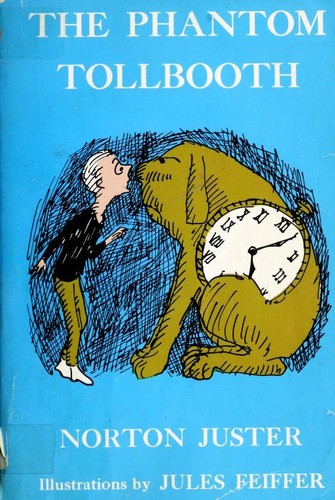
The Phantom Tollbooth
Norton Juster (1961)
“A boy who finds everything boring receives a magical tollbooth — and discovers that words, numbers, and ideas are the most extraordinary adventures of all.”
This page prints on a single page. Use Ctrl+P / Cmd+P.
The Phantom Tollbooth
Norton Juster (1961) · 256pages · Contemporary / Mid-Century Children's Literature
Summary
Milo, a bored boy who finds no purpose in anything, returns home one day to find a mysterious toy tollbooth in his room. He drives through it in his toy car and enters the Lands Beyond, where he journeys through Dictionopolis (ruled by King Azaz) and Digitopolis (ruled by the Mathemagician), rescues the exiled Princesses Rhyme and Reason from the Castle in the Air, and returns home having learned to find wonder in the ordinary world.
Why It Matters
Published in 1961 to moderate initial notice, The Phantom Tollbooth became a slow-building classic, selling over four million copies by the end of the 20th century. Unlike most children's classics of its era, it has never been out of print. It is unusual among children's books for having a genuin...
Themes & Motifs
Diction & Style
Register: Conversational but precise — uses sophisticated vocabulary with immediate comic or contextual clarification
Narrator: Third-person omniscient but with a warm, knowing adult presence — as if being read aloud by someone who has already m...
Figurative Language: Extreme
Historical Context
Early 1960s America — Sputnik anxiety, education reform, Cold War emphasis on math and science: The novel was written in the precise moment when American education was being asked to choose between humanities and sciences (Sputnik panic had elevated STEM concerns; traditionalists insisted on ...
Key Characters
Talking Points
- Milo is described as bored by everything 'not just sometimes, but always.' What is the difference between being bored sometimes and being bored always? What does Milo actually lack that he doesn't know he lacks?
- In the Doldrums, thinking is forbidden. Why would thinking be the one thing that's dangerous there? What does this tell you about what boredom actually is?
- Tock says 'tick' but is named 'Tock' because someone made a mistake. Why does Juster give the most reliable character in the book a name that doesn't match what he does?
- In Dictionopolis, you literally eat your words. What does this idiom usually mean when people say it in real life? How does making it literal change your understanding of what the phrase means?
- King Azaz says words are more important than numbers. The Mathemagician says numbers are more important than words. Rhyme and Reason said they are equally important — and both kings banished them for it. Why is 'both are equally important' such an unsatisfying answer to people who want to win an argument?
Notable Quotes
“There was once a boy named Milo who didn't know what to do with himself — not just sometimes, but always.”
“It seems to me that almost everything is a waste of time... I can't see the point in learning to solve useless problems, or subtracting turnips fro...”
“You can't get anywhere if you don't know where you're going.”
Why Read This
Because it is a book about why books matter — why words matter, why numbers matter, why paying attention matters. Every pun is a small proof that language is alive and worth loving. If you read it carefully, you'll never hear a common phrase quite...