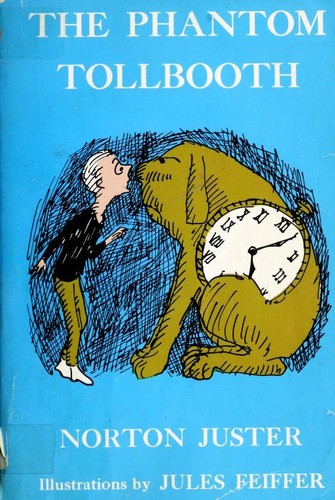
The Phantom Tollbooth
Norton Juster (1961)
“A boy who finds everything boring receives a magical tollbooth — and discovers that words, numbers, and ideas are the most extraordinary adventures of all.”
The Phantom Tollbooth— Historical Context & Author Background
Author: Norton Juster · Published 1961· Era: Contemporary / Mid-Century Children's Literature·256 pages
Themes explored: curiosity, learning, language, boredom, adventure, logic, imagination, appreciation
About Norton Juster
Norton Juster (1929-2021) was an architect and city planner who wrote The Phantom Tollbooth as a distraction from a difficult project — he was supposed to be writing a book about urban environments for a Ford Foundation grant and kept procrastinating by writing a children's fantasy instead. The book was illustrated by his roommate Jules Feiffer, a cartoonist for the Village Voice. Juster was trained in precision (architecture demands it) but loved language play and puns. The book was written quickly, from genuine play rather than calculated intent, which is why it feels so free.
Life → Text Connections
How Norton Juster's real experiences shaped specific elements of The Phantom Tollbooth.
Juster was an architect — trained to think about how spaces are organized, how you move through them, what purposes they serve
The geography of the Lands Beyond is architecturally deliberate: each kingdom is physically organized around its central concept (Dictionopolis has markets of words, Digitopolis has mines of numbers)
The spatial logic of the book is an architect's logic — form follows function, the landscape teaches as you move through it
Juster was procrastinating on a serious work project when he wrote the book — a kind of structured boredom, not unlike Milo's
Milo's boredom and subsequent discovery of wonder in unexpected places mirrors Juster's own experience writing the book
The book is autobiographical in its deepest structure: a man who couldn't find meaning in assigned work discovered it by playing
Jules Feiffer's illustrations — satirical, angular, slightly unsettling — were not typical children's book art but political cartoon art applied to fantasy
The Humbug's design, the Lethargians' shapes, the demons of ignorance — all drawn to be slightly comic-grotesque, not cute
The illustrations tell children this is a serious book in a funny world, not a funny book in a serious world — the visual register matches the text's dual address
Historical Era
Early 1960s America — Sputnik anxiety, education reform, Cold War emphasis on math and science
How the Era Shapes the Book
The novel was written in the precise moment when American education was being asked to choose between humanities and sciences (Sputnik panic had elevated STEM concerns; traditionalists insisted on the value of literature and rhetoric). Juster's response — Dictionopolis and Digitopolis in equal exile of their shared wisdom — is a direct intervention in that debate. The novel argues that the split is false and damaging. Rhyme and Reason must be rescued from both sides.
Why The Phantom Tollbooth Matters Historically
Published in 1961 to moderate initial notice, The Phantom Tollbooth became a slow-building classic, selling over four million copies by the end of the 20th century. Unlike most children's classics of its era, it has never been out of print. It is unusual among children's books for having a genuine philosophical argument: that curiosity is the foundation of a meaningful life, and that words and numbers — the tools of thought — are worth loving for their own sake.
- One of the first children's novels to make language itself — puns, idioms, etymology — the central subject and source of adventure
- Pioneered the 'allegorical journey as educational entertainment' format that many children's novels since have followed
- One of the first books to argue explicitly that the humanities/STEM divide in education is a false and harmful choice
Rarely challenged, though occasionally flagged in fundamentalist contexts for using magic and fantasy. More commonly, it has been dismissed by educators who consider it 'too clever' or worry that children won't get the jokes. The concern is ironic: the novel is precisely about the importance of giving children access to difficult, playful, ambitious ideas.