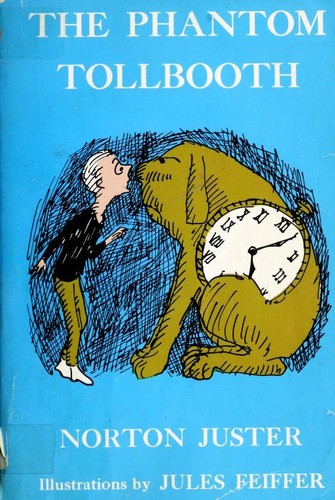
The Phantom Tollbooth
Norton Juster (1961)
“A boy who finds everything boring receives a magical tollbooth — and discovers that words, numbers, and ideas are the most extraordinary adventures of all.”
Language Register
Conversational but precise — uses sophisticated vocabulary with immediate comic or contextual clarification
Syntax Profile
Juster's sentences vary dramatically: simple declaratives for plot action, elaborate nested constructions for comic wordplay. He favors the sudden pivot — a sentence that begins seriously and ends absurdly, or begins absurdly and ends in genuine wisdom. Dialogue is crisp and fast; descriptions are inventive and sensory. The prose never condescends.
Figurative Language
Extreme — but the figurative language IS the content. Every metaphor, pun, and idiom is simultaneously a joke, a lesson, and a plot event. The novel doesn't use figurative language to describe the story; the story is made of figurative language made literal.
Era-Specific Language
A booth where you pay a toll to pass — common in mid-century American highway culture, now increasingly obsolete
Homophone pair central to the character Faintly Macabre — 'which' as a job title, 'witch' as its corrupted form
An old-fashioned word for nonsense or a person who speaks it — the Humbug character embodies confident bluster
Archaic: the time given for confession before execution; 'short shrift' = minimal consideration
Originally a nautical term for ocean zones with no wind where ships became stranded; extended to mean listlessness or depression
How Characters Speak — Class & Identity
King Azaz
Formal, pompous, uses elaborate vocabulary in ways that reveal more vanity than precision — he loves words as symbols of his own authority
The danger of treating language as status rather than communication — words as ornament rather than meaning
The Mathemagician
Precise, technical, genuinely enthusiastic — his language is full of quantifiers and conditionals, logical qualifications
Mathematics as a way of thinking, not just calculating — but also the limitation of pure precision without humanistic context
The Humbug
Loud, confident, full of grandiose claims and colorful expressions, almost always wrong — his language signals expertise he doesn't have
The gap between confidence and competence; the danger of mistaking fluency for knowledge
Tock
Steady, measured, literal — he says exactly what he means and means exactly what he says, with a watchdog's loyalty to precision
The value of clarity and reliability; trustworthy language as the foundation of trustworthy relationships
Milo
Begins flat and minimal; grows more curious, more willing to ask questions, more responsive to words and numbers as his journey progresses
Language as a measure of engagement — his expanding vocabulary of interest tracks his expanding curiosity
Narrator's Voice
Third-person omniscient but with a warm, knowing adult presence — as if being read aloud by someone who has already made the journey and wants you to notice everything. The narrator occasionally winks at the reader, but never at Milo's expense. The voice trusts the child reader completely.
Tone Progression
Chapters 1-3
Flat, then increasingly playful
Opens in Milo's boredom register — flat prose, simple vocabulary. As the Lands Beyond open up, the language becomes inventive and joyful. The prose shift mirrors Milo's awakening.
Chapters 4-9
Exuberant, pedagogical, comic
The sustained middle of the journey — wordplay dense and constant, allegories stacking. Every scene introduces a new linguistic or mathematical concept. The tone is celebratory.
Chapters 10-20
Tense, then triumphant, then wistful
The dangers of the Mountains of Ignorance require real courage. The rescue is genuinely exciting. The return home is bittersweet — Milo's world is richer, but the tollbooth has moved on.
Stylistic Comparisons
- Lewis Carroll's Alice in Wonderland — same structure of a child in an allegorical world where language has unexpected properties, but Juster is warmer and more pedagogically explicit
- C.S. Lewis's The Chronicles of Narnia — allegorical world-building, but Juster's allegory is linguistic rather than theological
- Edwin Abbott's Flatland — mathematical allegory as accessible fiction, though Juster is funnier and less formal
Key Vocabulary from This Book
Notable words used in this text — click to see full definitions