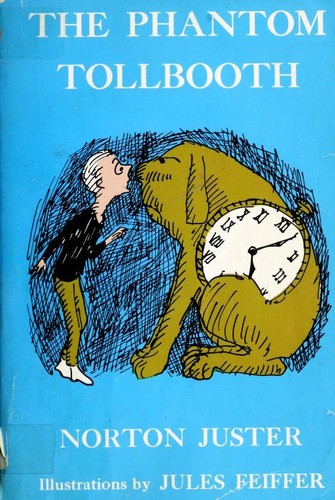
The Phantom Tollbooth
Norton Juster (1961)
“A boy who finds everything boring receives a magical tollbooth — and discovers that words, numbers, and ideas are the most extraordinary adventures of all.”
Why This Book Matters
Published in 1961 to moderate initial notice, The Phantom Tollbooth became a slow-building classic, selling over four million copies by the end of the 20th century. Unlike most children's classics of its era, it has never been out of print. It is unusual among children's books for having a genuine philosophical argument: that curiosity is the foundation of a meaningful life, and that words and numbers — the tools of thought — are worth loving for their own sake.
Firsts & Innovations
One of the first children's novels to make language itself — puns, idioms, etymology — the central subject and source of adventure
Pioneered the 'allegorical journey as educational entertainment' format that many children's novels since have followed
One of the first books to argue explicitly that the humanities/STEM divide in education is a false and harmful choice
Cultural Impact
Adapted as an animated film in 1970 featuring the voices of Mel Blanc and Daws Butler
Taught in middle-school English classes as an introduction to allegory, figurative language, and the history of idioms
The phrase 'the Doldrums' entered children's vocabulary through this book — Juster popularized the metaphorical use of the nautical term
Used by linguistics and English teachers as a way to introduce the concept of dead metaphors and etymology
A stage musical adaptation has been performed by school theater programs since the 1970s
Banned & Challenged
Rarely challenged, though occasionally flagged in fundamentalist contexts for using magic and fantasy. More commonly, it has been dismissed by educators who consider it 'too clever' or worry that children won't get the jokes. The concern is ironic: the novel is precisely about the importance of giving children access to difficult, playful, ambitious ideas.