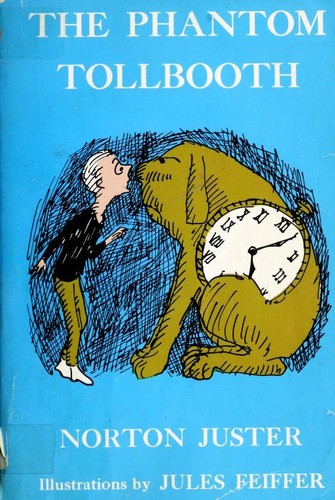
The Phantom Tollbooth
Norton Juster (1961)
“A boy who finds everything boring receives a magical tollbooth — and discovers that words, numbers, and ideas are the most extraordinary adventures of all.”
Essay Questions & Food for Thought
30questions designed to challenge assumptions and provoke original thinking. These can't be answered from a summary — you need the actual text.
Milo is described as bored by everything 'not just sometimes, but always.' What is the difference between being bored sometimes and being bored always? What does Milo actually lack that he doesn't know he lacks?
In the Doldrums, thinking is forbidden. Why would thinking be the one thing that's dangerous there? What does this tell you about what boredom actually is?
Tock says 'tick' but is named 'Tock' because someone made a mistake. Why does Juster give the most reliable character in the book a name that doesn't match what he does?
In Dictionopolis, you literally eat your words. What does this idiom usually mean when people say it in real life? How does making it literal change your understanding of what the phrase means?
King Azaz says words are more important than numbers. The Mathemagician says numbers are more important than words. Rhyme and Reason said they are equally important — and both kings banished them for it. Why is 'both are equally important' such an unsatisfying answer to people who want to win an argument?
Juster takes dead idioms — phrases like 'without rhyme or reason,' 'eating your words,' 'jumping to conclusions' — and makes them literal. What is a 'dead metaphor'? Find an idiom from everyday life and explain what it would look like if it came literally true.
The Whether Man governs WHETHER things happen, not WEATHER. The mix-up is a homophone error. Can you think of three other homophone pairs (words that sound alike but mean different things) that could cause confusion — or comedy — if mixed up?
The five brothers all have the same name — 'Ough' — but pronounce it five different ways. These are all real English pronunciations of 'ough' (enough, bough, though, through, cough). Why is English spelling so inconsistent? Is this a flaw in the language or a feature?
Faintly Macabre was a 'Royal Which' who controlled which words people could use. If you could forbid five words from being used, which would you choose — and what would be the unintended consequences of removing them?
The Humbug is always wrong and always confident. Have you ever known someone like this? What makes confident-but-wrong people so difficult to deal with — and why do people sometimes follow them anyway?
Alec Bings sees the world from adult height as a child because that's where he'll be when he grows up. What might you be able to see from a child's perspective that adults can't? What do adults see that children miss?
Chroma the Great conducts an orchestra that plays the colors of the sunrise. What would happen if no one 'played' the sunrise? Does Juster think beauty happens automatically, or does it require attention and effort?
The Soundkeeper locked away all sound because people misused it. Is this a good solution to the problem of noise? What is lost when silence is enforced? What might be a better solution?
The number mine in Digitopolis suggests that numbers exist in nature, waiting to be discovered. But some mathematicians argue that numbers are invented by humans, not discovered. Which do you think is right — and does it matter?
Milo receives a box of letters in Dictionopolis that can spell any word. He uses them to escape from a difficult situation. If you had a box of letters that could spell any word, what word would be the most useful to have in a crisis — and why?
The Terrible Trivium assigns people pointless tasks (moving sand with tweezers, etc.) that will take until the end of time. He argues that at least they'll never be bored. Is endless pointless work better than boredom? What makes a task worth doing?
The Senses Taker steals your senses one by one until you can't pay attention to anything. What would it feel like to have your sense of curiosity taken away? How would your life change if you stopped noticing things?
At the end of the book, Milo looks at his ordinary bedroom and thinks it is full of extraordinary things to do, see, and wonder at. What changed — his room, or Milo? What did the journey give him that he didn't have before?
The tollbooth moves on to someone else after Milo returns home. Who do you think receives it next? Write two or three sentences describing the new recipient and explain why they need it.
Juster wrote this book to procrastinate from another project. Many great creative works were made by accident or distraction. Does knowing this change how you feel about the book? Does the 'reason' a work was made affect its value?
Find a common phrase in everyday speech that is actually a dead metaphor — one that was once a vivid image but has become so ordinary people forget it's figurative. Explain the original image and what it would look like if taken literally.
The book argues that both words and numbers are equally important. Do you agree? Can you think of a situation where one is clearly more important than the other? Can you think of a situation where you need both at the same time?
Milo is about your age. Do you recognize his boredom? Have you ever found something you thought was pointless suddenly interesting? What made the difference — the subject, or something that changed in how you were looking at it?
Juster was an architect who wrote a book full of words — his non-word profession fed his word book. Can you think of other pairs of seemingly different skills that actually help each other? (Math and music, drawing and engineering, cooking and chemistry?)
If you were designing the Lands Beyond, what new kingdom would you add — a place whose subject or skill or domain had been exiled from the rest of the world? What would its city look like? Who would rule it?
The novel was published in 1961, when American schools were being pressured to focus on math and science because of Sputnik. Does knowing this change how you read the rivalry between Dictionopolis and Digitopolis?
The Phantom Tollbooth is sometimes described as a book that children love and adults love for different reasons. What might an adult get from this book that a child doesn't — and what might a child see that an adult has lost?
Compare Milo to Alice in Wonderland. Both are children who enter strange allegorical worlds through unexpected passages. How are their journeys different in what they learn and how they change?
Juster uses the names of his characters to describe them: Faintly Macabre, Short Shrift, the Mathemagician, the Soundkeeper. Choose a character from your own life — a teacher, a relative, a friend — and invent a Juster-style name that captures who they are in two or three words.
Tock tells Milo that wasted time is the one thing you can never get back. Is this true? What does it mean to 'waste' time — is watching TV a waste? Is daydreaming? Is there a difference between resting and wasting?