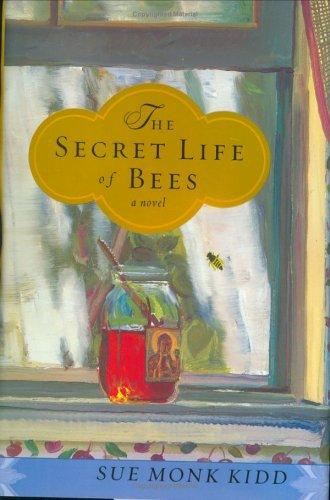
The Secret Life of Bees
Sue Monk Kidd (2002)
“A fourteen-year-old girl fleeing a lie about her mother finds what she was actually looking for: a family she chose and a faith she built herself.”
Language Register
Conversational-literary — warm, immediate, Southern in cadence, metaphor-dense but not demanding
Syntax Profile
Lily's narration is close, first-person, and present-feeling even in retrospect. Sentences are medium length with frequent metaphors drawn from the natural world. Southern cadence visible in dialogue. August speaks in structured, unhurried sentences. T. Ray speaks in short, blunt commands. The syntax maps personality with precision.
Figurative Language
High, especially in natural-world metaphors — bees, honey, heat, seasons. Kidd rarely lets a major emotional moment pass without a governing image. The risk is over-writing; she mostly navigates it by keeping metaphors grounded in the novel's literal apiary setting.
Era-Specific Language
1964 racial designation — used by white characters; the novel's diction marks power through word choice
Tobacco product associated with working-class Southern women — Rosaleen's jar is a signature of her dignity and defiance
The active work of claiming civil rights in the post-Civil Rights Act South — not a formality but a dangerous act
Resin bees use to seal hives — Kidd uses specific beekeeping vocabulary to ground metaphors in physical reality
N/A — compare to Gatsby: Kidd's characters don't perform class through language in the same way; authenticity of voice is the contrast
How Characters Speak — Class & Identity
Lily
Educated beyond her environment — she reads everything, her metaphors are literary — but her voice is still Southern and adolescent. She code-switches between farm-girl and aspiring writer.
She is always slightly out of place: too literary for Sylvan, too white for the Boatwright house, too young for what's being asked of her. Her diction is the register of the in-between.
August
Measured, deliberate, aphoristic. Does not rush. Sentences are complete and balanced. She speaks like a person accustomed to being understood by those who are listening and ignored by those who aren't, and she has made peace with the distinction.
Education, dignity, and authority that were acquired without institutional recognition. The South gave her nothing; she made everything she is anyway.
T. Ray
Short sentences, commands, cruelty delivered in plain language. He has no poetry in him, which is Kidd's indictment: a man who can't access metaphor can't access empathy.
Emotional closure masquerading as hardness. The prose style of a man who stopped trying to understand things at some point and started demanding them instead.
Rosaleen
Direct, unadorned, frequently funny. Her sarcasm is dry and Southern. She does not perform for anyone, which is both her greatest dignity and, in 1964 South Carolina, her greatest vulnerability.
A woman who has not been given the luxury of indirection. Directness as survival strategy and as character.
Narrator's Voice
Lily Owens: first-person, retrospective-feeling but immediate, lyrical and adolescent simultaneously. She is both the child experiencing the summer and the slightly-older writer assembling it. Kidd keeps this tension productive — the narrator knows more than the character but not everything, and the gap is where the reader lives.
Tone Progression
Chapters 1-3
Desperate, frightened, searching
Lily is on the run, literally and emotionally. The prose is urgent and slightly wild.
Chapters 4-8
Curious, enchanted, uneasy
The Boatwright house is a world Lily doesn't fully understand. She is learning and hiding simultaneously.
Chapters 9-11
Grief-stricken, cracking open, receiving
May's death and August's truth-telling demolish Lily's defenses. The prose becomes starker.
Chapters 12-14
Settled, grateful, claimed
Lily has arrived. The prose relaxes into belonging. The lyrical voice is no longer reaching — it has landed.
Stylistic Comparisons
- Harper Lee's To Kill a Mockingbird — Southern, first-person child narrator, race and justice in the foreground, but Lee's Atticus is heroic while Kidd's adults are complicated
- Toni Morrison's Beloved — both novels center motherhood, grief, and Black feminine spiritual life; Kidd writes from outside that experience while Morrison writes from within
- Alice Walker's The Color Purple — epistolary where Bees is narrative, but both center female community as salvation and both locate the divine feminine in women's relationships
Key Vocabulary from This Book
Notable words used in this text — click to see full definitions