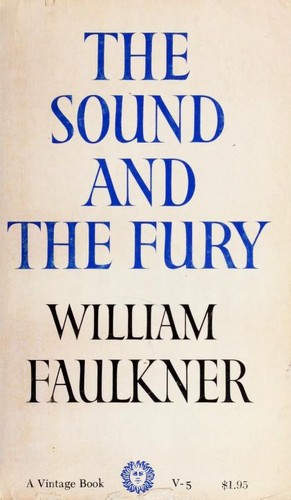
The Sound and the Fury
William Faulkner (1929)
“Four voices. Four narrators. One family destroying itself in real time — and Faulkner gives the first chapter to the one who cannot understand what he's telling you.”
This page prints on a single page. Use Ctrl+P / Cmd+P.
The Sound and the Fury
William Faulkner (1929) · 326pages · American Modernism / Southern Gothic · 18 AP appearances
Summary
The Compson family of Jefferson, Mississippi collapses over three days in April 1928, told through four radically different narrators: Benjy (intellectually disabled, no sense of time), Quentin (suicidal Harvard student in 1910), Jason (bitter, mercenary, the functional 'normal' brother), and Dilsey (the Black servant who holds what's left together). The novel's subject is the decay of the Old South through one aristocratic family — their loss of land, money, honor, and sanity — and the gap between how each mind constructs the same catastrophe.
Why It Matters
The Sound and the Fury is the novel Faulkner himself called his best — his most ambitious, his most agonized, and his least commercial. It was passed over by readers for years, understood only by a small audience, and then rescued by academic criticism in the 1940s and 50s. It is now recognized a...
Themes & Motifs
Diction & Style
Register: Each section has its own register. Benjy: paratactic, sensory, no hierarchy. Quentin: literary, fragmented, increasingly unpunctuated. Jason: colloquial, comic, declarative. Dilsey: formal third person with vernacular dialect in dialogue and sermon.
Narrator: Four narrators, four radically different epistemic positions. Benjy: omnipresent but non-interpretive. Quentin: omnis...
Figurative Language: Extremely high in Benjy and Quentin; lower (by design) in Jason and Dilsey. The tree-climbing scene (Caddy and the muddy drawers), the branch scenes, the watch, the Confederate monument
Historical Context
Post-Civil War American South — Reconstruction's aftermath, Jim Crow, the end of the plantation aristocracy: The Compson family's collapse is inseparable from the South's. The land sold to pay for Quentin's Harvard education was pasture that had once been plantation. The Black servants who sustain the hou...
Key Characters
Talking Points
- Faulkner gives the first — and hardest — section of the novel to Benjy, the narrator who understands the least. Why start here? What do we gain from experiencing the story first through a mind that cannot interpret it?
- Caddy Compson is the central figure of the novel but never narrates. Faulkner said she was his 'heart's darling.' Why did he silence her? Would the novel be better or worse if she had her own section?
- The novel is told out of chronological order: April 7 (Benjy), then June 2 1910 (Quentin), then April 6 (Jason), then April 8 (Dilsey). Why arrange the sections this way? What is lost and gained by this non-linear structure?
- Quentin's incest fantasy — his wish that he and Caddy had committed incest — is not about desire but about something else entirely. What is it about, and why is it the most important thing he tells his father?
- Jason IV is probably the most despicable narrator in American literature — and yet his section is the funniest. Why does Faulkner make his monster entertaining? What is the reader supposed to feel about laughing at Jason?
Notable Quotes
“Caddy smelled like trees in the rain.”
“I could hear the clock and the fire and Father in the library.”
“Through the fence, between the curling flower spaces, I could see them hitting.”
Why Read This
Because nothing else teaches you what language can actually do. Most novels tell you what happened. The Sound and the Fury shows you how minds experience what happened — and those minds are unreliable, self-interested, and grieving in ways they ca...