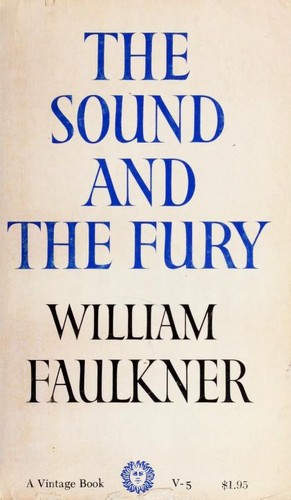
The Sound and the Fury
William Faulkner (1929)
“Four voices. Four narrators. One family destroying itself in real time — and Faulkner gives the first chapter to the one who cannot understand what he's telling you.”
Why This Book Matters
The Sound and the Fury is the novel Faulkner himself called his best — his most ambitious, his most agonized, and his least commercial. It was passed over by readers for years, understood only by a small audience, and then rescued by academic criticism in the 1940s and 50s. It is now recognized as one of the two or three most formally innovative novels in American literature — the experiment that proved stream of consciousness could work in American prose as it had for Joyce in Irish prose.
Firsts & Innovations
First major American novel to use multiple unreliable narrators telling the same story from irreconcilable perspectives
First sustained American deployment of stream-of-consciousness narration as structural architecture rather than local technique
First novel to use an intellectually disabled narrator (Benjy) as primary consciousness — and to make that choice thematically essential rather than exploitative
Cultural Impact
The Nobel Prize citation for Faulkner specifically named his 'powerful and artistically unique contribution to the modern American novel'
Established the 'Yoknapatawpha' fictional county as one of literature's great invented geographies — comparable to Hardy's Wessex or García Márquez's Macondo
Influenced every subsequent Southern Gothic writer: Flannery O'Connor, Cormac McCarthy, Toni Morrison, Barry Hannah
Toni Morrison wrote her dissertation on Faulkner; her own narrative experiments in Beloved and The Sound and the Fury share formal DNA
The title, from Macbeth — 'a tale / Told by an idiot, full of sound and fury, / Signifying nothing' — became one of literature's most resonant self-descriptions
Banned & Challenged
Challenged in school curricula for racial slurs (the word appears throughout, especially in Jason's section), for sexual content (Caddy's promiscuity and pregnancy, Quentin's incest fantasy), and for general difficulty — some school boards have objected not to the content but to the form, arguing that a deliberately confusing novel has no educational value. The latter objection rather proves the point.