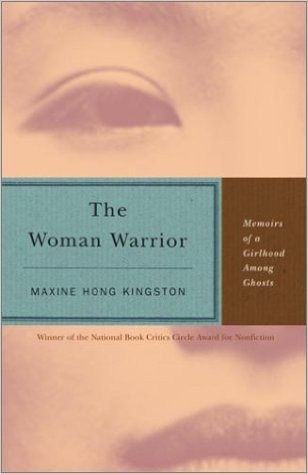
The Woman Warrior
Maxine Hong Kingston (1976)
“A Chinese-American daughter untangles what is myth, what is memory, and what silence has buried — and discovers that telling stories is the only way to survive.”
Language Register
Fluid and shifting — moves between mythic incantation, domestic memoir, ethnographic documentation, and adolescent intimacy without signaling transitions
Syntax Profile
Kingston uses long, accumulative sentences for the mythic and memory passages, cataloguing images and possibilities. Her declarative sentences tend to be blunt and angular — reports from inside an impossible situation. The book is full of conditional tenses ('perhaps she had,' 'I think') that signal honest uncertainty rather than false authority.
Figurative Language
High — metaphor clusters around silence (weight, water, crippling), voice (sword, carving, song), and ghosts (erasure, haunting, substitution). Kingston's figures are tactile: she makes abstract oppressions physical.
Era-Specific Language
Chinese-American oral storytelling tradition; narratives passed down as warning, instruction, or entertainment — the book's central formal inheritance
Whites are called 'ghosts' — pale, insubstantial, moving through Chinese-American life without touching or understanding it
Chinese immigrant term for America — specifically California; the mythologized land of wealth that rarely delivers what it promises
'Fresh off the boat' — Chinese-American slang distinguishing recent immigrants from those who have assimilated; Kingston herself occupies neither category cleanly
Kingston's approximate transliteration; the curse her mother cut under her tongue — 'to lessen her shyness' — which Kingston later reimagines as a gift of speech
How Characters Speak — Class & Identity
Brave Orchid
Authoritative, declarative, code-switching between Cantonese and English. Her English is heavily accented but her authority is not diminished by it.
A woman who was credentialed and powerful in one context; immigration reduced her to a laundry worker, but her language still carries the residue of the woman she was.
Kingston (young)
Switches between eloquent English and silence; between the mythic register of talk-stories and the flat, embarrassed register of American school.
The bilingual child's navigational exhaustion — fluent in two languages, fully at home in neither.
Moon Orchid
Cantonese-only; her speech becomes increasingly disordered as her mental state deteriorates. Cannot access English at all.
Language as survival infrastructure. Without it, identity cannot sustain itself in a foreign country.
The No Name Woman
Silent — we have no access to her actual speech. Kingston gives her imagined interiority but no recorded voice.
The erasure is complete only when language is removed. The entire book is an attempt to restore what silence has taken.
Narrator's Voice
Kingston: multiple, layered, intentionally unreliable. She inhabits Fa Mu Lan in first person. She reconstructs her mother's past she wasn't present for. She admits she cannot verify which stories she was told and which she invented. This is not unreliability as failure but as formal argument: the stories that make us are always partially fabricated, and claiming otherwise is the real dishonesty.
Tone Progression
No Name Woman
Searching, transgressive, elegiac
The opening act of literary disobedience. Kingston tells the story she was told not to tell, and then goes further, imagining the woman behind the prohibition.
White Tigers
Mythic, exhilarating, bittersweet
The book's most lyric and elevated section. The fantasy of female power is intoxicating before the return to reality deflates it.
Shaman
Admiring, ambivalent, bereaved
Kingston at her most generous toward Brave Orchid — and aware of what immigration cost her mother before she could form the resentments she carries.
At the Western Palace
Tragic, detached, documentary
Kingston withdraws from the page. The flat third-person prose tracks a woman's erasure with the affect of a coroner's report.
A Song for a Barbarian Reed Pipe
Anguished, cathartic, reconciliatory
The book's emotional center of gravity, where everything that has been silenced finally speaks — imperfectly, partially, and at cost.
Stylistic Comparisons
- Toni Morrison's Beloved — both books make suppressed female history haunt the present as literal and figurative ghost
- Sandra Cisneros's The House on Mango Street — coming-of-age in an immigrant community, negotiating between cultural inheritance and American identity
- Gloria Anzaldúa's Borderlands/La Frontera — the theorization of the liminal identity that Kingston enacts in fiction
Key Vocabulary from This Book
Notable words used in this text — click to see full definitions