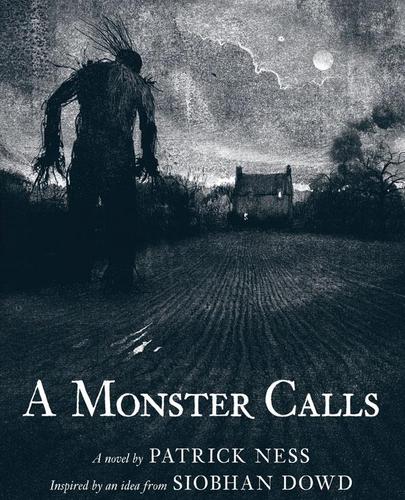
A Monster Calls
Patrick Ness (from an idea by Siobhan Dowd) (2011)
“A boy whose mother is dying summons a monster made of yew — the tree that grows in graveyards and produces the chemical used in chemotherapy. The monster does not come to heal. It comes to make Conor tell the truth.”
This page prints on a single page. Use Ctrl+P / Cmd+P.
A Monster Calls
Patrick Ness (from an idea by Siobhan Dowd) (2011) · 215pages · Contemporary · 1 AP appearances
Summary
Thirteen-year-old Conor O'Malley is dealing with his mother's terminal cancer when a yew tree monster visits him at 12:07 a.m. The monster tells Conor three stories that systematically dismantle fairy-tale logic — no clear heroes, no clean morals — then demands Conor tell a fourth: the truth about his recurring nightmare. Conor must finally admit that he wants his mother's suffering to end, even if that means she dies. The monster catches him as he lets go.
Why It Matters
Won the Carnegie Medal in 2012 — the first book to win both the Carnegie and the Kate Greenaway Medal (for Kay's illustrations) simultaneously, the only time this has happened in the awards' combined 150+ year history. Established a new category of children's literature: the 'illustrated literary...
Themes & Motifs
Diction & Style
Register: Accessible contemporary prose with precisely controlled shifts into archaic fairy-tale register for the monster's stories
Narrator: Third-person limited, locked tightly to Conor's perspective. The narration knows only what Conor knows and feels only...
Figurative Language: Moderate and precise. Ness avoids extended metaphor in favor of symbol (the yew tree, the nightmare, the clock at 12:07). When figurative language appears, it tends toward the visceral and physical rather than the abstract
Historical Context
Early 21st century Britain — contemporary children's literature, cancer treatment advances, evolving grief narratives: A Monster Calls emerged at a moment when children's literature was expanding its emotional range beyond what had previously been considered 'age-appropriate.' The post-Potter publishing landscape c...
Key Characters
Talking Points
- The monster insists Conor called it, but Conor denies this throughout the novel. Who is right? At what point — if ever — does Conor accept that he summoned the monster, and what does that acceptance signify?
- Why does Ness set the monster's arrival at 12:07 a.m. instead of midnight? What does this seemingly minor detail reveal about the novel's relationship to literary convention?
- In the first story, the prince is both a murderer and a good king. How does this paradox prepare Conor — and the reader — for the novel's final confession?
- The yew tree is simultaneously a graveyard tree (poisonous berries, planted among the dead) and the source of taxol, a chemotherapy drug. How does this botanical fact function as the novel's central metaphor?
- Why does the apothecary refuse to help the parson's daughters, even though he has the medicine? Is the apothecary cruel, principled, or both — and how does your answer apply to the monster's treatment of Conor?
Notable Quotes
“The monster showed up just after midnight. As they do.”
“I've come to get you, Conor O'Malley... You called me. I am here.”
“There is not always a good guy. Nor is there always a bad one. Most real people are somewhere in between.”
Why Read This
Because grief is not a problem with a solution, and this is one of the few books honest enough to say so. The monster's three stories will teach you more about how narratives actually work — subverting expectations, refusing easy morals, building ...