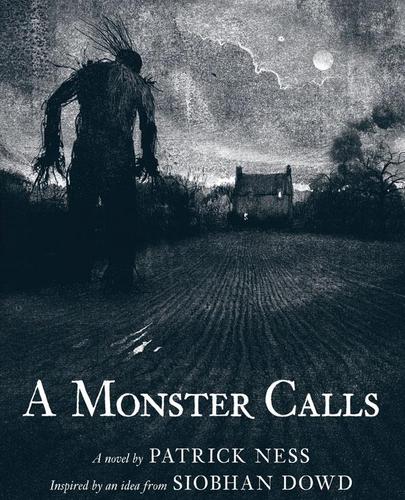
A Monster Calls
Patrick Ness (from an idea by Siobhan Dowd) (2011)
“A boy whose mother is dying summons a monster made of yew — the tree that grows in graveyards and produces the chemical used in chemotherapy. The monster does not come to heal. It comes to make Conor tell the truth.”
Essay Questions & Food for Thought
30questions designed to challenge assumptions and provoke original thinking. These can't be answered from a summary — you need the actual text.
The monster insists Conor called it, but Conor denies this throughout the novel. Who is right? At what point — if ever — does Conor accept that he summoned the monster, and what does that acceptance signify?
Why does Ness set the monster's arrival at 12:07 a.m. instead of midnight? What does this seemingly minor detail reveal about the novel's relationship to literary convention?
In the first story, the prince is both a murderer and a good king. How does this paradox prepare Conor — and the reader — for the novel's final confession?
The yew tree is simultaneously a graveyard tree (poisonous berries, planted among the dead) and the source of taxol, a chemotherapy drug. How does this botanical fact function as the novel's central metaphor?
Why does the apothecary refuse to help the parson's daughters, even though he has the medicine? Is the apothecary cruel, principled, or both — and how does your answer apply to the monster's treatment of Conor?
Conor's headmistress refuses to punish him after he hospitalizes Harry. She says, 'I think you've been punished enough.' Why is this the cruelest thing anyone does to Conor in the novel?
Jim Kay's illustrations shift register across the novel — expressionistic ink-wash for the monster's stories, sharper lines for the real world, near-abstraction for the nightmare. Why can this novel not be fully experienced without the illustrations?
Siobhan Dowd conceived A Monster Calls and died of breast cancer before writing it. Patrick Ness completed it. How does knowing the novel's creation story change your reading of its themes about stories and mortality?
Harry the bully treats Conor more honestly than any other character at school. Defend or challenge this reading using textual evidence.
Compare the monster's three stories to traditional fairy tales (Grimm, Perrault, Andersen). What specific expectations does each story set up and then subvert, and why does this subversion matter for Conor's emotional arc?
Conor's grandmother keeps a pristine sitting room that Conor destroys. What does this room represent, and why must it be destroyed for Conor's emotional breakthrough to occur?
The monster says: 'You do not write your life with words. You write it with actions. What you think is not always what you do.' Is this distinction — between thought and action — philosophically defensible? Are there dangers in telling a grieving child that their darkest thoughts don't count?
Conor's father lives in America with a new family and gently tells Conor there is 'no room' for him. Is the father a villain, a coward, or simply honest? How does his inadequacy differ from active cruelty?
The novel ends with the monster holding Conor as his mother dies. What is the monster at this moment — hallucination, metaphor, magical reality, or something the novel deliberately refuses to categorize?
Lily told classmates about Conor's mother's cancer out of empathy, not malice. Is Conor's anger at Lily justified, displaced, or both? What does the novel suggest about the relationship between good intentions and harmful outcomes?
Compare A Monster Calls to Where the Wild Things Are. Both feature children who summon monsters to process emotions they cannot articulate. How does Ness extend Sendak's premise, and what emotional territory does he access that Sendak's picture-book form cannot?
The three stories each operate on multiple levels — as fairy tales, as parables about Conor's situation, and as philosophical arguments. Choose one story and identify all three levels. Where do they converge, and where do they diverge?
How would this novel function differently if Conor were six years old instead of thirteen? What specific narrative choices depend on his being an adolescent — old enough to understand death but young enough to lack the language for grief?
The novel distinguishes between 'wanting something to be over' and 'wanting someone to die.' Is this distinction real, or is it a comforting fiction the monster offers Conor? Argue both sides.
The 2016 film adaptation uses animated watercolor sequences for the monster's stories. What is gained and lost in translating Jim Kay's static ink-wash illustrations into moving animation?
The monster tells Conor that stories 'chase and bite and hunt.' Is this description of narrative supported by the novel's own structure? In what ways does A Monster Calls hunt its reader toward a truth they might prefer to avoid?
Why does the novel never give Conor's mother a name? She is always 'Mum' or 'his mother.' What does this choice accomplish narratively and emotionally?
The invisible man story is the shortest and simplest of the three, yet it produces the most violent response from Conor. Why does simplicity hit harder here than the elaborate moral puzzles of the first two stories?
Ness chose to write his own novel from Dowd's concept rather than attempting to complete Dowd's book. What is the ethical and artistic difference between these two approaches, and how does the choice parallel the novel's themes?
Compare Conor's grandmother to any other literary guardian figure (Aunt Polly, Miss Havisham, Uncle Vernon). How does Ness complicate the trope of the stern guardian, and what does the sitting-room scene reveal about the grandmother's own grief?
The novel argues that humans can simultaneously hold contradictory truths: Conor loves his mother AND wants her suffering to end. Is this psychologically accurate? What does cognitive science say about ambivalent grief?
If the monster had offered to heal Conor's mother — if the yew tree's medicine actually worked in the story — would the novel be more or less powerful? What would be lost by providing a magical cure?
The novel's three embedded stories systematically dismantle fairy-tale logic: moral certainty, the power of belief to heal, and the safety of invisibility. What fourth fairy-tale assumption does Conor's own story dismantle?
Read the scene where Conor tells the nightmare aloud. How does Ness's sentence structure change — length, rhythm, punctuation — during the confession? What is the prose doing physically that mirrors what Conor is doing emotionally?
A Monster Calls is used in bereavement counseling for children. Is this a legitimate use of a novel, or does therapeutic application reduce literature to self-help? Can a book be both a work of art and a clinical tool without compromising either function?