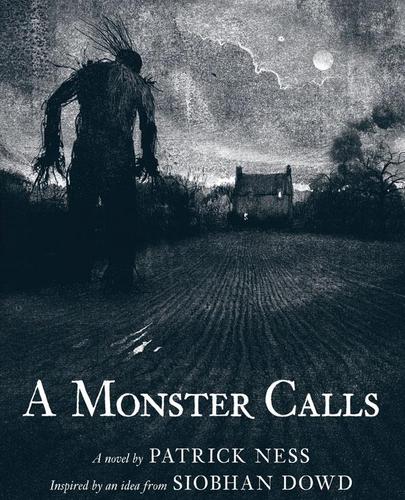
A Monster Calls
Patrick Ness (from an idea by Siobhan Dowd) (2011)
“A boy whose mother is dying summons a monster made of yew — the tree that grows in graveyards and produces the chemical used in chemotherapy. The monster does not come to heal. It comes to make Conor tell the truth.”
Language Register
Accessible contemporary prose with precisely controlled shifts into archaic fairy-tale register for the monster's stories
Syntax Profile
Short declarative sentences in Conor's perspective — rarely more than ten words during emotional peaks. The monster's stories use longer, subordinate-clause-heavy constructions that evoke oral storytelling. Ness controls sentence length as emotional choreography: short sentences during violence and confession, longer sentences during reflection and myth.
Figurative Language
Moderate and precise. Ness avoids extended metaphor in favor of symbol (the yew tree, the nightmare, the clock at 12:07). When figurative language appears, it tends toward the visceral and physical rather than the abstract — hands slipping, wood cracking, ink bleeding across a page.
Era-Specific Language
The monster's arrival time — deliberately not midnight, rejecting symbolic convenience for the mundane specificity of real grief
Taxus baccata — the graveyard tree that produces taxol (chemotherapy compound). Symbol of simultaneous death and healing
The monster's stories use 'there was once' and archaic syntax, signaling oral tradition while subverting its moral structures
Repeated as both threat and promise — the monster's demand, Conor's terror, the novel's argument that grief requires honesty
Conor's experience of pity as erasure — being seen only through his mother's illness, never as himself
How Characters Speak — Class & Identity
Conor
Clipped, guarded, contemporary British adolescent. Avoids emotional vocabulary. Communicates through action and silence.
A boy who has run out of language for what he feels. The poverty of his emotional vocabulary is the novel's central problem — the monster provides the stories Conor cannot construct for himself.
The Monster
Shifts between archaic storytelling register and blunt, declarative commands. 'There was once' gives way to 'Tell me the truth.'
The monster is both ancient and immediate — it carries millennia of narrative tradition but speaks to Conor's specific, contemporary grief. The register shift IS the character.
Grandma
Formal, controlled, precise. Complete sentences. Emotional restraint encoded in syntax.
A woman holding herself together through language. Her formality is not coldness — it is the last structural support preventing collapse.
Conor's Mum
Warm, casual, deliberately optimistic. Uses pet names and deflection.
A dying woman performing normalcy for her son. Her cheerful diction is itself a kind of lie, and Conor senses this, which is part of what drives his rage.
Narrator's Voice
Third-person limited, locked tightly to Conor's perspective. The narration knows only what Conor knows and feels only what Conor allows himself to feel — which means the narration is, like Conor, suppressing the truth for most of the novel. The gaps in the narration (the undescribed nightmare, the unfinished sentences) are as important as the text.
Tone Progression
Opening — Monster's arrival
Tense, guarded, flatly supernatural
Conor is too exhausted by real fear to be frightened by fantasy. The tone is numb.
The three stories
Mythic, subversive, increasingly personal
Each story moves closer to Conor's reality. The fairy-tale register cracks as the parallels sharpen.
School and family
Naturalistic, angry, claustrophobic
The real world sections press in. The prose tightens. Conor's isolation becomes physical.
The fourth story and ending
Raw, stripped, quietly devastating
All register collapses. The prose becomes as bare as Conor's confession. No ornament. No metaphor. Just truth.
Stylistic Comparisons
- Neil Gaiman (The Ocean at the End of the Lane) — similar use of fantasy as grief mechanism, but Gaiman is more whimsical; Ness is more brutal
- Markus Zusak (The Book Thief) — both use non-human narrators to approach death from an oblique angle
- C.S. Lewis (A Grief Observed) — Lewis's adult grief memoir parallels Ness's child grief novel; both insist on honesty over comfort
- Maurice Sendak (Where the Wild Things Are) — the foundational text: a child processes difficult emotions through monsters. Ness extends this into terminal illness
Key Vocabulary from This Book
Notable words used in this text — click to see full definitions