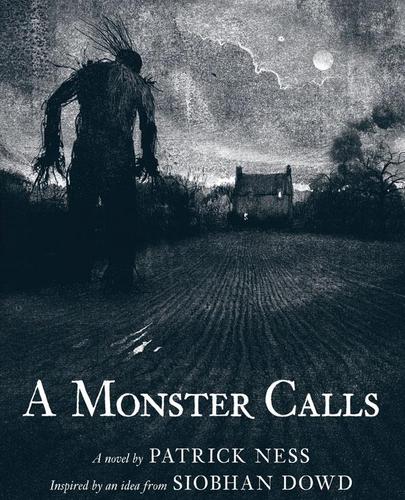
A Monster Calls
Patrick Ness (from an idea by Siobhan Dowd) (2011)
“A boy whose mother is dying summons a monster made of yew — the tree that grows in graveyards and produces the chemical used in chemotherapy. The monster does not come to heal. It comes to make Conor tell the truth.”
A Monster Calls— Historical Context & Author Background
Author: Patrick Ness (from an idea by Siobhan Dowd) · Published 2011· Era: Contemporary·215 pages
Themes explored: grief, truth, anger, stories-as-healing, guilt, acceptance, loss
About Patrick Ness (from an idea by Siobhan Dowd)
Patrick Ness (born 1971 in Fort Bragg, Virginia; raised in Washington state; lives in London) is an American-British author best known for the Chaos Walking trilogy and A Monster Calls. Siobhan Dowd (1960-2007) was an Irish-English children's author who conceived the novel's premise — a monster visiting a boy whose mother is dying — but died of breast cancer at forty-seven before writing it. Dowd's publisher, Walker Books, asked Ness to write the novel from Dowd's concept. Ness has described the experience as one of the most significant creative challenges of his career: writing a book about a mother dying of cancer when the book itself was born from a woman dying of cancer. The meta-grief is inextricable from the text.
Life → Text Connections
How Patrick Ness (from an idea by Siobhan Dowd)'s real experiences shaped specific elements of A Monster Calls.
Siobhan Dowd conceived the novel's premise — a monster visiting a boy with a dying mother — then died of breast cancer before writing it
The entire novel is structured around the relationship between stories and death — stories that survive their tellers, grief that demands articulation
The novel's central argument — that stories outlive their creators, that narrative is how we process mortality — is literally enacted by its own creation. Dowd's death is the fourth story the novel doesn't explicitly tell.
Ness wrote the book from another writer's concept, creating something new from someone else's unfinished vision
The monster tells stories that are not Conor's but become Conor's — external narratives that unlock internal truths
The collaborative authorship mirrors the novel's structure: someone else's stories (the monster's) help Conor access his own truth, just as Dowd's idea helped Ness access a novel he could not have conceived alone.
Ness has spoken publicly about choosing not to imitate Dowd's voice but to write his own novel from her concept
The monster is not Conor's mother — it is an independent entity with its own ancient perspective that happens to address Conor's specific pain
Ness's artistic decision to honor Dowd's concept without ventriloquizing her voice parallels the monster's role: present, helpful, but fundamentally other. The book is Dowd's and Ness's simultaneously, belonging fully to neither.
Jim Kay developed the illustrations alongside Ness's text, not after it — the visual and verbal narratives grew together
The illustrations are structurally integral: the monster's stories exist in expressionistic ink-wash; the real world in sharper, sparser lines; the nightmare in near-abstraction
The book cannot be fully experienced without the illustrations. This makes A Monster Calls one of the rare novels where the physical object — the page, the ink, the paper — is part of the literary argument.
Historical Era
Early 21st century Britain — contemporary children's literature, cancer treatment advances, evolving grief narratives
How the Era Shapes the Book
A Monster Calls emerged at a moment when children's literature was expanding its emotional range beyond what had previously been considered 'age-appropriate.' The post-Potter publishing landscape created space for books that treated young readers as capable of engaging with death, moral ambiguity, and psychological complexity. Simultaneously, advances in cancer treatment created the specific medical reality the novel inhabits: Conor's mother undergoes treatments that extend life without curing disease, creating the liminal space of chronic terminal illness that defines his experience. The yew tree's dual identity — graveyard presence and chemotherapy source — is a product of this specific medical-cultural moment.
Why A Monster Calls Matters Historically
Won the Carnegie Medal in 2012 — the first book to win both the Carnegie and the Kate Greenaway Medal (for Kay's illustrations) simultaneously, the only time this has happened in the awards' combined 150+ year history. Established a new category of children's literature: the 'illustrated literary novel' that is neither picture book nor chapter book but a genuine hybrid form. Became the standard text for teaching grief and loss in schools and therapeutic settings.
- First and only book to win both the Carnegie Medal and Kate Greenaway Medal simultaneously
- One of the first major children's novels to depict anticipatory grief — the grief that begins before death, not after
- Pioneered the 'illustrated literary novel' as a distinct form — illustrations as co-equal narrative, not decoration
- One of the first children's novels whose creation story (Dowd's death) became inseparable from its themes
Occasionally challenged in schools for 'dark themes' and depictions of violence (Conor's attack on Harry, the destruction of the grandmother's room). Defenders argue that the book's entire purpose is to model healthy engagement with grief and anger — removing it from curricula would reinforce the exact silence the novel argues against.