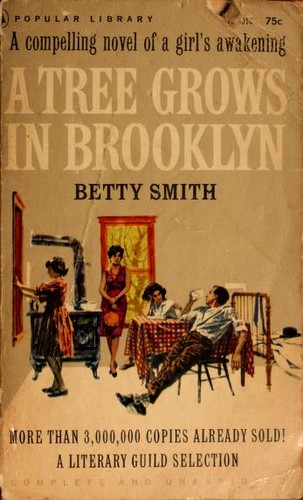
A Tree Grows in Brooklyn
Betty Smith (1943)
“A girl in the Brooklyn tenements discovers that reading, writing, and sheer stubbornness can grow through concrete — just like the Tree of Heaven in her backyard.”
This page prints on a single page. Use Ctrl+P / Cmd+P.
A Tree Grows in Brooklyn
Betty Smith (1943) · 493pages · American Realism / Coming-of-Age · 3 AP appearances
Summary
Francie Nolan grows up in the Williamsburg tenements of Brooklyn in the early 1900s, the daughter of a charming but alcoholic singing waiter and a fiercely pragmatic cleaning woman. Through poverty, hunger, her father's death, workplace exploitation, and the upheavals of World War I, Francie clings to education and reading as her way out — embodying the Tree of Heaven that grows through cement in every Brooklyn yard, beautiful to nobody, impossible to kill.
Why It Matters
Published in 1943, A Tree Grows in Brooklyn was an instant bestseller — 300,000 copies in its first year. It arrived during WWII, when Americans were hungry for stories of resilience and immigrant grit. The novel became a cultural touchstone for the working class: millions of readers saw their ow...
Themes & Motifs
Diction & Style
Register: Accessible, warm, and deceptively simple — conversational narration with Brooklyn dialect in dialogue and lyrical passages about reading and nature
Narrator: Third-person limited, anchored primarily in Francie's consciousness but occasionally shifting to Katie, Johnny, or an...
Figurative Language: Low to moderate
Historical Context
1900s-1918 Brooklyn — Immigration era, pre-Prohibition, World War I: The novel sits at the hinge point between old-world immigrant poverty and new-world opportunity. Public libraries and public schools are the mechanisms of assimilation, but they serve the poor unev...
Key Characters
Talking Points
- Why does Smith open the novel with a tree rather than a character? What does beginning with the Tree of Heaven do to your expectations for the story that follows?
- Katie chooses to keep Neeley in school instead of Francie, even though Francie is the better student. Is Katie right? Wrong? Both? How does the novel want you to feel about this decision?
- Johnny Nolan is charming, loving, talented, and an alcoholic who can't support his family. How does Smith prevent us from either hating him or excusing him? What narrative techniques keep both truths alive simultaneously?
- Francie reads every book in the library in alphabetical order. What does this method of reading — democratic, systematic, undirected — tell us about her relationship to education?
- Grandma Mary Rommely is illiterate and speaks no English, yet she prescribes the novel's educational philosophy: Shakespeare, the Bible, and a savings bank. Why does Smith make the wisest character the one furthest from formal education?
Notable Quotes
“No matter where its seed fell, it made a tree which struggled to reach the sky.”
“She liked the way the the words looked all strung out on the paper.”
“The secret lies in the reading and the writing. You are able to read. Every day you must read one page from some good book to your child.”
Why Read This
Because Francie Nolan is the reader who reads her way out. If you've ever felt invisible in a classroom, if you've ever known that books understood you better than people did, if you've ever been told your real life isn't an appropriate topic for ...