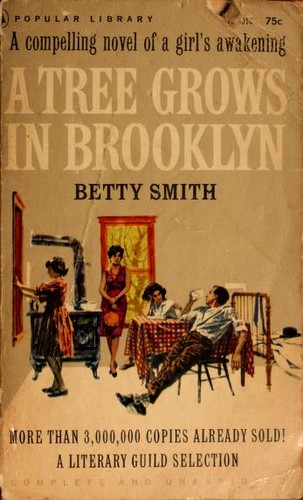
A Tree Grows in Brooklyn
Betty Smith (1943)
“A girl in the Brooklyn tenements discovers that reading, writing, and sheer stubbornness can grow through concrete — just like the Tree of Heaven in her backyard.”
Essay Questions & Food for Thought
30questions designed to challenge assumptions and provoke original thinking. These can't be answered from a summary — you need the actual text.
Why does Smith open the novel with a tree rather than a character? What does beginning with the Tree of Heaven do to your expectations for the story that follows?
Katie chooses to keep Neeley in school instead of Francie, even though Francie is the better student. Is Katie right? Wrong? Both? How does the novel want you to feel about this decision?
Johnny Nolan is charming, loving, talented, and an alcoholic who can't support his family. How does Smith prevent us from either hating him or excusing him? What narrative techniques keep both truths alive simultaneously?
Francie reads every book in the library in alphabetical order. What does this method of reading — democratic, systematic, undirected — tell us about her relationship to education?
Grandma Mary Rommely is illiterate and speaks no English, yet she prescribes the novel's educational philosophy: Shakespeare, the Bible, and a savings bank. Why does Smith make the wisest character the one furthest from formal education?
The librarian in Francie's branch library never once looks at her or acknowledges her. Why does Smith include this detail? How does the library save Francie despite the librarian's indifference?
Compare Katie and Johnny as two responses to poverty. Katie is pragmatism (arithmetic, cleaning, saving); Johnny is imagination (singing, dreaming, drinking). Does the novel argue that one response is better, or that both are necessary?
Francie writes a composition about poverty and her teacher rejects it, telling her to write about 'beautiful' things instead. What is Smith arguing about the purpose of literature through this scene?
Aunt Sissy is banned from the Nolan household for being a 'bad influence,' but she is also the family's warmest and most generous member. What does the gap between her reputation and her character reveal about the community's values?
The novel ends with Francie seeing a young girl reading on a fire escape — a new version of herself. Why is this cyclical ending more powerful than a triumphant ending where Francie succeeds individually?
How does Smith use food — its presence, absence, and quality — as a class indicator throughout the novel? Choose three food scenes and analyze what each reveals about the Nolans' economic position.
Sergeant McShane is everything Johnny was not — reliable, sober, steady. Why doesn't the novel present Katie's choice of McShane as a betrayal of Johnny's memory? What has the novel taught us about romance vs. survival?
Smith was born in Williamsburg, left school after eighth grade, and educated herself at the library — exactly like Francie. Does knowing this autobiography changes how you read the novel? Is the book more or less powerful as thinly veiled memoir?
The novel spans roughly 1901-1918. How does World War I change Brooklyn, the Nolan family, and Francie's opportunities? Is the war presented as liberation, disruption, or both?
Compare the Tree of Heaven to the green light in The Great Gatsby. Both are symbols of aspiration. How do they differ in what they promise, and what they deliver?
Why does Smith set the novel in the early 1900s but publish it in 1943, during World War II? What does looking back at immigrant Brooklyn offer a wartime American audience?
Francie lies about her age to get working papers, uses a false address to transfer schools, and conceals her poverty whenever possible. Are these lies moral failures or survival strategies? Does the novel distinguish between dishonesty and self-preservation?
Smith writes Brooklyn dialect phonetically in dialogue but keeps the narration in standard English. Why? What does this dual register create?
The vaccination scene — where a doctor uses the same needle on every child — prompts Katie to storm the school. What does this scene reveal about how public institutions treat the poor differently?
If A Tree Grows in Brooklyn were set in 2026, what would Francie's equivalent be? What would the 'library' be? The 'tree'? The 'working papers'?
Lee Rhynor proposes to Francie, then reveals he's already married. How does this betrayal complete Francie's education? What does she learn that school never taught her?
Sissy has multiple stillborn babies throughout the novel. Why does Smith include this recurring tragedy? What does it represent about women's bodies and women's choices in this era?
The Rommely sisters each represent a different survival strategy: Sissy (freedom), Evy (respectability), Eliza (religion), Katie (discipline). Which strategy does the novel endorse? Or does it argue that all four are necessary for the family to survive?
Francie's teacher rejects her writing about poverty but praises her when she writes about 'nicer' subjects. A later professor encourages her honest work. What distinguishes these two responses, and what does the difference say about education?
How does Smith handle the immigrant experience without making it the novel's central subject? The Rommelys are immigrants, but the novel is about poverty and education, not immigration per se. What does this framing choice accomplish?
Nick Carraway in The Great Gatsby says 'they were careless people.' Katie Nolan is the opposite of careless — she counts every penny, plans every meal, weighs every decision. Compare the moral frameworks of these two novels.
The Christmas tree scene — trees thrown at children, whoever doesn't fall gets to keep one — is one of the novel's most famous. Why does Smith present this violent generosity without irony or condemnation?
Ben Blake is presented as Francie's intellectual equal. Why does Smith make their relationship about conversation rather than romance? What is the novel arguing about what women need?
The tin-can land bank — pennies saved, nailed to the floor, never opened — is both practical savings and an act of faith. What does the land bank represent beyond money?
Smith's prose is deliberately plain — short sentences, concrete nouns, minimal metaphor. How does this style serve the story? Would more 'literary' prose improve the novel or betray it?