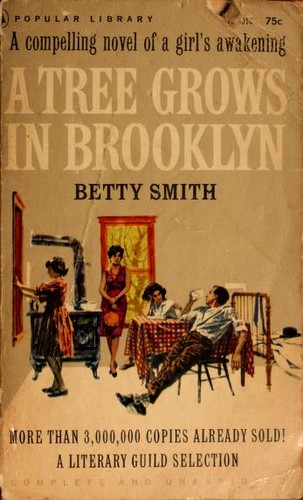
A Tree Grows in Brooklyn
Betty Smith (1943)
“A girl in the Brooklyn tenements discovers that reading, writing, and sheer stubbornness can grow through concrete — just like the Tree of Heaven in her backyard.”
A Tree Grows in Brooklyn— Summary & Analysis
by Betty Smith · published 1943 · 493 pages · American Realism / Coming-of-Age
A user-friendly study guide for A Tree Grows in Brooklyn by Betty Smith (1943): a high-level plot summary, full chapter-by-chapter analysis, theme breakdowns, character profiles, and 30 essay questions designed for middle-school, high-school, ap-english readers. Unlike a stock summary, sumsumsum.com adds a diction analysis drawn from Betty Smith’s actual text, the 3 documented AP Literature exam appearances of this book, and reading-difficulty guidance (Easy, 2/10) so students, teachers, and lifelong readers know what they are walking into.
“A girl in the Brooklyn tenements discovers that reading, writing, and sheer stubbornness can grow through concrete — just like the Tree of Heaven in her backyard.”
Short Summary
Francie Nolan grows up in the Williamsburg tenements of Brooklyn in the early 1900s, the daughter of a charming but alcoholic singing waiter and a fiercely pragmatic cleaning woman. Through poverty, hunger, her father's death, workplace exploitation, and the upheavals of World War I, Francie clings to education and reading as her way out — embodying the Tree of Heaven that grows through cement in every Brooklyn yard, beautiful to nobody, impossible to kill.
Detailed Summary
Francie Nolan is born in 1901 in Williamsburg, Brooklyn, into a world of tenement flats, penny-pinching, and immigrant dreams. Her mother Katie is a janitress who scrubs floors and stretches every cent with ruthless discipline. Her father Johnny is a union singing waiter — handsome, tender, Irish to...
Summary in the Author’s Writing Style
A retelling of A Tree Grows in Brooklyn in Betty Smith’s style — so you can hear the language, not just the plot. This is a stylistic pastiche written by sumsumsum, not an excerpt from the book.
Serene was the word for the summer of 1912 in Williamsburg, Brooklyn, if you did not look too hard. In the yards behind the tenements there grew a tree. It was the only tree that grew there. Some people called it the Tree of Heaven. It grew up out of the cement and it did not care that nobody wanted…
Chapter-by-Chapter Analysis
If you liked A Tree Grows in Brooklyn, read next
Start with The Great Gatsby by F. Scott Fitzgerald — The American Dream from opposite ends — Gatsby reaches from the top and falls, Francie climbs from the bottom and survives. Then try My Antonia by Willa Cather — Same plain prose, same respect for immigrant resilience, different geography — Nebraska's plains instead of Brooklyn's tenements. Or pivot to Angela's Ashes by Frank McCourt — The Irish-Catholic poverty narrative Smith helped invent, transplanted back to Ireland and told through a boy's voice.
For comparative essays, pair A Tree Grows in Brooklyn with
The strongest comparative pairing is The House on Mango Street (Sandra Cisneros) — Same project compressed into vignettes — a girl in a poor neighborhood writing her way toward a different life. Another productive pairing is David Copperfield (Charles Dickens) — The original child-poverty-to-literary-success novel — Smith's template, stripped of Dickens's sentimentality and coincidences. For a third angle, contrast with The Glass Castle (Jeannette Walls) — Non-fiction echo — another daughter of a charming, unreliable father and a complicated mother, escaping poverty through education.
Each of these pairings opens a clean thesis path on shared themes, period diction, or formal influence — useful for AP Lit / IB / first-year college comparative essays.