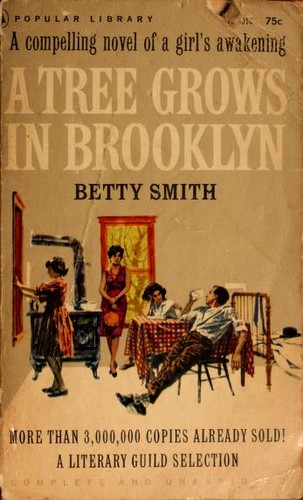
A Tree Grows in Brooklyn
Betty Smith (1943)
“A girl in the Brooklyn tenements discovers that reading, writing, and sheer stubbornness can grow through concrete — just like the Tree of Heaven in her backyard.”
A Tree Grows in Brooklyn— Historical Context & Author Background
Author: Betty Smith · Published 1943· Era: American Realism / Coming-of-Age·493 pages
Themes explored: poverty, education, immigrant-experience, gender, family, resilience, class, coming-of-age
About Betty Smith
Betty Smith (1896-1972) was born Elisabeth Wehner in Williamsburg, Brooklyn — the neighborhood she wrote about. Her family was German-Irish, not Irish like the Nolans, but the poverty was the same. She left school after eighth grade, worked in factories, and educated herself at the public library. She married at eighteen, had two daughters, and eventually talked her way into college courses at the University of Michigan without a high school diploma — exactly as Francie does. She wrote A Tree Grows in Brooklyn at forty-seven, drawing directly on her childhood. The novel was an immediate bestseller, selling 300,000 copies in its first year. She had been poor her entire life; the book made her famous overnight.
Life → Text Connections
How Betty Smith's real experiences shaped specific elements of A Tree Grows in Brooklyn.
Smith grew up in Williamsburg tenements and left school after eighth grade to work in factories
Francie's entire trajectory — the tenement childhood, the forced departure from school, the factory work
This is autobiography thinly veiled as fiction. The specificity of the poverty — the hunger, the junk collection, the working papers — is firsthand.
Smith educated herself at the public library, reading voraciously without guidance
Francie's library project — reading every book in alphabetical order, the librarian who never looks at her
The library scenes carry the weight of Smith's own salvation. The invisible librarian is a real wound — no one helped her, but the books were enough.
Smith attended the University of Michigan without a high school diploma, convincing admissions to let her in
Francie's acceptance to the University of Michigan in the novel's final chapters
Smith gives her protagonist the exact escape route she found. The specificity is not laziness — it's testimony.
Smith's father was a German immigrant who struggled with alcohol; her mother worked as a janitress
Johnny's alcoholism and Katie's janitorial work — the novel's central parental dynamic
The Johnny-Katie marriage is a reimagining of Smith's own parents. The tenderness toward Johnny and the respect for Katie are both deeply personal.
Historical Era
1900s-1918 Brooklyn — Immigration era, pre-Prohibition, World War I
How the Era Shapes the Book
The novel sits at the hinge point between old-world immigrant poverty and new-world opportunity. Public libraries and public schools are the mechanisms of assimilation, but they serve the poor unevenly — Francie gets more from the library than from any classroom. The war accelerates everything: women enter the workforce, neighborhoods reorganize, and the old ethnic enclaves begin to dissolve. Smith captures the immigrant generation's impossible double consciousness: grateful to America for the opportunity, furious at America for the conditions.
Why A Tree Grows in Brooklyn Matters Historically
Published in 1943, A Tree Grows in Brooklyn was an instant bestseller — 300,000 copies in its first year. It arrived during WWII, when Americans were hungry for stories of resilience and immigrant grit. The novel became a cultural touchstone for the working class: millions of readers saw their own childhoods in Francie's. It was one of the first major American novels to center a girl's intellectual awakening in the context of poverty, predating the 'women's literary fiction' category by decades.
- One of the first American novels to treat a girl's hunger for education as the central dramatic engine
- Pioneered the 'Brooklyn novel' as a literary genre — the template for subsequent generations of New York immigrant fiction
- One of the earliest bestsellers to depict poverty without either romanticizing it or treating it as moral failure
Occasionally challenged for sexual content (the Rhynor episode, Sissy's sexual freedom), depictions of alcoholism, and 'negative' portrayals of poverty. Also challenged for being 'depressing' — which, like Gatsby's 'un-American' challenges, rather proves the novel's point.