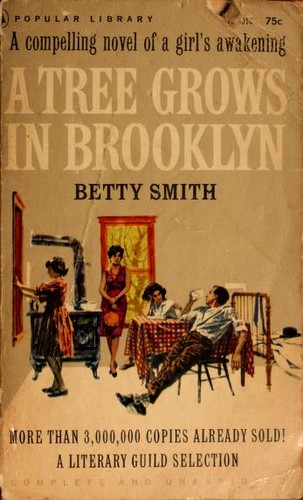
A Tree Grows in Brooklyn
Betty Smith (1943)
“A girl in the Brooklyn tenements discovers that reading, writing, and sheer stubbornness can grow through concrete — just like the Tree of Heaven in her backyard.”
Language Register
Accessible, warm, and deceptively simple — conversational narration with Brooklyn dialect in dialogue and lyrical passages about reading and nature
Syntax Profile
Short declarative sentences dominate — Smith averages 12-15 words per sentence, far shorter than her literary contemporaries. Paragraphs tend to be observation-heavy, building meaning through accumulation rather than complexity. Dialogue is rendered phonetically for Brooklyn Irish speakers ('gwan,' 'youse,' 'ain't') while narration stays grammatically clean. The gap between speech and narration mirrors the gap between the Nolans' lived experience and the literary world Francie aspires to.
Figurative Language
Low to moderate — Smith prefers concrete images over metaphor. The Tree of Heaven is the major exception: an extended symbol that Smith states rather than hides. When figurative language appears, it tends toward simple simile rather than complex metaphor. The restraint is deliberate — ornate prose would betray the world it describes.
Era-Specific Language
Female janitor — Katie's occupation, marking both her class and gender in the labor economy
Government documents permitting child labor — the bureaucratic gateway from school to factory
A tin pail of beer brought home from the saloon — daily ritual of tenement life
Elevated train — the infrastructure that defined Brooklyn's geography and soundscape
Improvised savings device — nailed to the floor to prevent temptation
How Characters Speak — Class & Identity
Francie Nolan
Internal narration is literary and observant; spoken dialogue is Brooklyn vernacular. The gap widens as she ages and reads more.
Francie lives between two languages — the books she reads and the street she lives on. Her voice IS the class divide.
Katie Nolan
Terse, practical, declarative. Speaks in short sentences. Rarely uses figurative language. Says less as pressure increases.
Katie's speech is poverty compressed into language — no wasted words, no wasted energy. Silence is her most powerful register.
Johnny Nolan
Musical, warm, slightly performative. Uses endearments, tells stories, sings. Sentences fragment as his drinking worsens.
Johnny's speech is his greatest asset and his mask. The music in his language is real; the stability it implies is not.
Aunt Sissy
Loud, physical, unfiltered. Brooklyn dialect at its broadest. Says what no one else will say.
Sissy's speech is freedom — she refuses to perform respectability. Her vulgarity is a form of honesty in a world of careful silences.
Grandma Mary Rommely
Speaks only German/Austrian dialect. Her wisdom is rendered in translation, always slightly formal.
The immigrant voice — profound understanding of America delivered through a language America doesn't speak. The wisest character is the one the country can't hear.
Narrator's Voice
Third-person limited, anchored primarily in Francie's consciousness but occasionally shifting to Katie, Johnny, or an omniscient overview. The narrator's warmth is consistent but never sentimental — Smith looks directly at poverty, hunger, and injustice without flinching or moralizing. The voice matures with Francie: child's-eye simplicity in early chapters, young-adult complexity by the end.
Tone Progression
Books 1-2 (Chapters 1-20)
Observant, warm, wonder-tinged
Francie's child perspective renders poverty as the texture of normal life. The prose is curious and cataloging — Williamsburg as a world to be inventoried.
Book 3 (Chapters 21-34)
Darkening, elegiac, grief-stricken
Johnny's decline and death strip the warmth from the narration. The prose compresses. Sentences shorten. The cataloging gives way to survival mathematics.
Books 4-5 (Chapters 35-56)
Resilient, maturing, cautiously hopeful
Francie's working life and education rebuild the narrative's warmth on a harder foundation. The prose earns its hope through everything that preceded it.
Stylistic Comparisons
- Dickens — the child's-eye poverty narrative, but without Dickens's coincidences and sentimentality
- Willa Cather — similar plainness of prose, similar respect for immigrant experience, different geography
- Sandra Cisneros, The House on Mango Street — same project (girl escaping poverty through language) compressed into vignettes
Key Vocabulary from This Book
Notable words used in this text — click to see full definitions