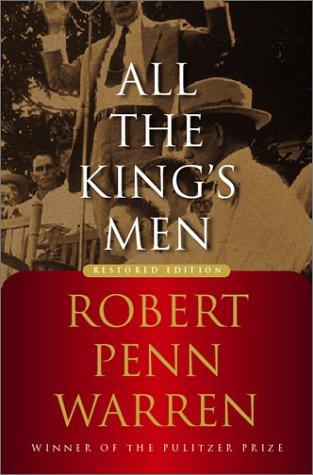
All the King's Men
Robert Penn Warren (1946)
“A man who believed in nothing watches a man who believed in everything seize a state by the throat — and discovers that the nothing he believed in was just the truth he refused to look at.”
This page prints on a single page. Use Ctrl+P / Cmd+P.
All the King's Men
Robert Penn Warren (1946) · 464pages · Modernist · 9 AP appearances
Summary
Jack Burden, a disillusioned journalist turned political operative, narrates the rise and fall of Willie Stark, a Southern governor who begins as a dirt-road idealist and becomes a ruthless demagogue. As Jack carries out Willie's orders — digging up dirt on enemies, destroying reputations — he discovers that every person he loves is connected to every crime he uncovers, and that the philosophy of detachment he has cultivated since childhood is not wisdom but cowardice. The novel is about what happens when you find out the truth about people and then have to decide whether knowing the truth makes you responsible for what happens next.
Why It Matters
All the King's Men won the Pulitzer Prize for Fiction in 1947 and is consistently ranked among the greatest American novels of the twentieth century. It established the political novel as a form capable of philosophical depth — not merely a story about elections and power plays but a meditation o...
Themes & Motifs
Diction & Style
Register: Mixed. Jack's philosophical reflections are highly formal and rhetorically complex. His descriptions of political action are colloquial, punchy, almost journalistic. Willie's speeches are raw, populist, biblical in rhythm. The register shifts track Jack's emotional state: when he is detached, the prose is ornate; when he is wounded, it goes flat.
Narrator: Jack Burden is one of American literature's great narrators — unreliable not because he lies but because his intellig...
Figurative Language: Very high. Warren was a poet (he won the Pulitzer for poetry as well as fiction), and his prose is saturated with metaphor, simile, and symbolic imagery. The spider web, the twitch, the highway, the hospital, the house of the past
Historical Context
The American South during the Great Depression — populist politics, machine governance, and the collision between aristocratic tradition and democratic demagoguery: The Depression made Willie Stark possible. When people are hungry and the roads are unpaved and the hospitals are hours away, a man who builds roads and hospitals can be forgiven almost anything. L...
Key Characters
Talking Points
- Jack Burden calls his philosophy the 'Great Twitch' — the idea that all human behavior is mechanical and morally meaningless. At what point in the novel does this philosophy become unsustainable, and what replaces it?
- Willie Stark builds roads, hospitals, and schools — real achievements that help real people. Does the novel ask us to weigh these achievements against his corruption? Is there a calculus that makes Willie's methods acceptable?
- The novel is narrated entirely by Jack Burden, but Jack admits he is unreliable — his detachment is a defense mechanism, not a neutral position. How would the novel be different if narrated by Willie? By Anne? By Adam?
- Warren insisted that Willie Stark was not Huey Long. Do the differences between the fictional character and the historical figure matter? What does fiction accomplish that biography cannot?
- Cass Mastern's spider web metaphor — that touching any point sends vibrations to every other point — is the philosophical core of the novel. Map the spider web of the plot: which actions vibrate to which consequences, and where does Jack fit in the web?
Notable Quotes
“To get where we were going we had to go down the highway which was new, broad, and slick as a ribbon of black satin.”
“Man is conceived in sin and born in corruption and he passeth from the stink of the didie to the stench of the shroud.”
“The end of man is knowledge, but there is one thing he can't know. He can't know whether knowledge will save him or kill him.”
Why Read This
Because you live in a world of political strongmen, populist promises, and people who tell you the system is rigged — and this novel, written eighty years ago, understood all of it better than anything on your news feed. Jack Burden is the smartes...