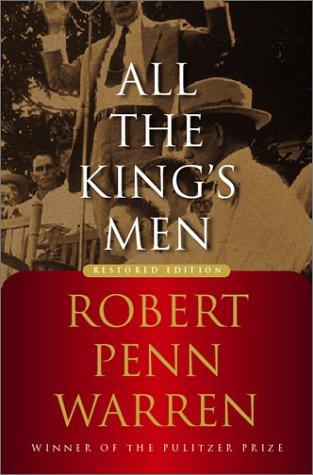
All the King's Men
Robert Penn Warren (1946)
“A man who believed in nothing watches a man who believed in everything seize a state by the throat — and discovers that the nothing he believed in was just the truth he refused to look at.”
Language Register
Mixed. Jack's philosophical reflections are highly formal and rhetorically complex. His descriptions of political action are colloquial, punchy, almost journalistic. Willie's speeches are raw, populist, biblical in rhythm. The register shifts track Jack's emotional state: when he is detached, the prose is ornate; when he is wounded, it goes flat.
Syntax Profile
Warren writes in long, complex, heavily subordinated sentences that build through accumulation — clause after clause adding nuance, qualification, and metaphor until the sentence arrives at its destination with the force of something that has gathered weight over distance. His paragraphs can run for pages. The effect is a narrator who cannot stop thinking, who must turn every observation into philosophy, who uses language itself as a buffer between himself and direct experience. When the buffer fails — when Jack is genuinely surprised or wounded — the sentences shorten dramatically, and the contrast is devastating.
Figurative Language
Very high. Warren was a poet (he won the Pulitzer for poetry as well as fiction), and his prose is saturated with metaphor, simile, and symbolic imagery. The spider web, the twitch, the highway, the hospital, the house of the past — all carry symbolic weight that Warren layers rather than announces. His nature imagery is particularly dense: the Louisiana landscape functions as both setting and moral commentary.
Era-Specific Language
Willie Stark as political 'boss' — the Southern strongman who controls through patronage, threats, and personal loyalty
Jack's term for any investigation — clinical language that frames moral inquiry as procedure
The coastal aristocratic enclave where Jack grew up — named for his family, embodying the weight of inheritance
Jack's philosophy of mechanistic determinism — all action is reflex, none is moral
Political slang for compromising information — Jack's job is to find the 'dirt,' and the word carries its literal connotation of soil, filth, the ground
How Characters Speak — Class & Identity
Jack Burden
Educated, literary, allusive — quotes philosophy, history, and literature with the ease of someone for whom culture is ambient
Jack's intelligence is his inheritance from both worlds — the old money of Burden's Landing and the political cunning of his work for Willie. His prose style is itself a class marker: only someone who grew up with books talks like this.
Willie Stark
Shifts between populist vernacular ('Man is conceived in sin') and sophisticated political calculation — code-switches depending on audience
Willie's linguistic range IS his political genius. He speaks the language of the crowds when he needs their votes and the language of power when he needs cooperation. The shift between registers is conscious, strategic, and eventually second nature.
Adam Stanton
Precise, clinical, morally absolute — speaks in declaratives with no qualifications
Adam's language mirrors his worldview: clean, binary, uncompromising. There are no subordinate clauses in his moral reasoning. This clarity makes him a great surgeon and a terrible politician.
Tiny Duffy
Crude, ingratiating, empty — uses political cliches and flattery as his entire vocabulary
Duffy has no inner life that his language reveals. He is pure surface, pure transaction. His words are instruments of manipulation, never of thought.
Judge Irwin
Formal, patrician, measured — the language of the old Southern aristocracy deployed with genuine dignity
Irwin speaks the way Jack was raised to speak. His language is the sound of the world Jack is trying to reject — and the world that, despite its corruption, produced something Jack recognized as love.
Narrator's Voice
Jack Burden is one of American literature's great narrators — unreliable not because he lies but because his intelligence is deployed in the service of avoidance. He sees everything, understands everything, and uses that understanding to construct a philosophy (the Great Twitch) that exempts him from responsibility. His voice is sardonic, learned, deeply Southern in its rhythms, and ultimately self-lacerating: by the novel's end, he narrates his own demolition with the same precision he used to narrate everyone else's.
Tone Progression
Chapters 1-3 (The Rise)
Sardonic, detached, blackly comic
Jack narrates Willie's rise from the comfortable distance of someone who has already decided nothing matters.
Chapters 4-5 (The Investigation)
Procedural, increasingly uneasy
The clinical tone of research begins to crack as the facts lead closer to home.
Chapters 6-7 (The Destruction)
Wounded, evasive, then numb
Jack discovers the affair, flees to California, enters the Great Sleep. The prose goes flat.
Chapter 8 (The Great Twitch)
Philosophical, defensive, then stripped bare
Jack articulates and then loses his philosophy. The prose moves from elaborate to devastatingly simple.
Chapters 9-10 (The Fall and After)
Elegiac, accepting, cautiously forward-looking
The sardonic voice is gone. What replaces it is not optimism but responsibility — a harder, less entertaining, more honest voice.
Stylistic Comparisons
- Fitzgerald's Nick Carraway — another educated narrator watching a powerful man self-destruct, but Jack is more complicit and more self-aware about his complicity
- Dostoevsky's Crime and Punishment — the same investigation of whether knowing makes you responsible, the same discovery that philosophical detachment is itself a moral crime
- Faulkner's Absalom, Absalom! — Southern history as tragedy, the past as a burden the present cannot escape, and a narrator who reconstructs the story as a way of understanding himself
Key Vocabulary from This Book
Notable words used in this text — click to see full definitions