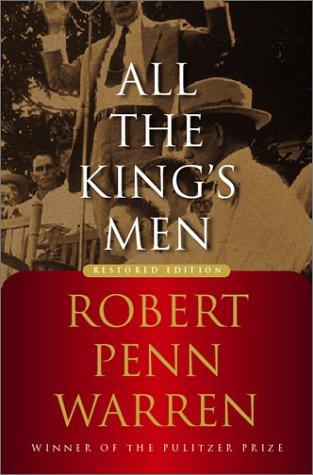
All the King's Men
Robert Penn Warren (1946)
“A man who believed in nothing watches a man who believed in everything seize a state by the throat — and discovers that the nothing he believed in was just the truth he refused to look at.”
All the King's Men— Summary & Analysis
by Robert Penn Warren · published 1946 · 464 pages · Modernist
A user-friendly study guide for All the King's Men by Robert Penn Warren (1946): a high-level plot summary, full chapter-by-chapter analysis, theme breakdowns, character profiles, and 30 essay questions designed for ap-english, college readers. Unlike a stock summary, sumsumsum.com adds a diction analysis drawn from Robert Penn Warren’s actual text, the 9 documented AP Literature exam appearances of this book, and reading-difficulty guidance (Moderate, 4/10) so students, teachers, and lifelong readers know what they are walking into.
“A man who believed in nothing watches a man who believed in everything seize a state by the throat — and discovers that the nothing he believed in was just the truth he refused to look at.”
Short Summary
Jack Burden, a disillusioned journalist turned political operative, narrates the rise and fall of Willie Stark, a Southern governor who begins as a dirt-road idealist and becomes a ruthless demagogue. As Jack carries out Willie's orders — digging up dirt on enemies, destroying reputations — he discovers that every person he loves is connected to every crime he uncovers, and that the philosophy of detachment he has cultivated since childhood is not wisdom but cowardice. The novel is about what happens when you find out the truth about people and then have to decide whether knowing the truth makes you responsible for what happens next.
Detailed Summary
Jack Burden is a man who has made a career of not caring. A former graduate student in history who abandoned his dissertation, a former newspaper reporter who drifted into politics, he is now the chief researcher and fixer for Willie Stark, the governor of an unnamed Southern state that is unmistaka...
Summary in the Author’s Writing Style
A retelling of All the King's Men in Robert Penn Warren’s style — so you can hear the language, not just the plot. This is a stylistic pastiche written by sumsumsum, not an excerpt from the book.
You drive down the slab toward Mason City and the white line comes at you out of the heat-shimmer, ticking under the hood like the second hand of a clock that does not care whether you arrive, and if you are the kind of man I was you can ride that line a long way and tell yourself it is taking you s…
Chapter-by-Chapter Analysis
If you liked All the King's Men, read next
Start with The Great Gatsby by F. Scott Fitzgerald — Another educated narrator watching a self-made titan build an empire on illusion — but where Nick Carraway merely observes, Jack Burden participates, and the moral stakes are correspondingly higher. Then try The Sound and the Fury by William Faulkner — The other great Southern modernist novel about the burden of the past — where Faulkner fragments consciousness to show the past invading the present, Warren uses a single narrator whose detachment IS the invasion. Or pivot to Crime and Punishment by Fyodor Dostoevsky — The same investigation of whether intellectual justification can absorb the moral weight of action — Raskolnikov's theory that great men are above morality is the Great Twitch in Russian dress.
For comparative essays, pair All the King's Men with
The strongest comparative pairing is Invisible Man (Ralph Ellison) — Published six years later — another novel about a narrator whose identity is shaped by powerful men who use him, and who must reconstruct his selfhood after discovering the machinery he served.
Each of these pairings opens a clean thesis path on shared themes, period diction, or formal influence — useful for AP Lit / IB / first-year college comparative essays.