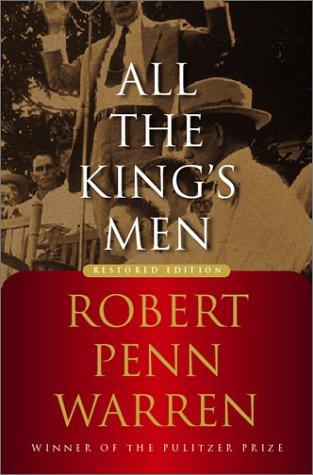
All the King's Men
Robert Penn Warren (1946)
“A man who believed in nothing watches a man who believed in everything seize a state by the throat — and discovers that the nothing he believed in was just the truth he refused to look at.”
All the King's Men— Historical Context & Author Background
Author: Robert Penn Warren · Published 1946· Era: Modernist·464 pages
Themes explored: power, corruption, truth, morality, identity, fate, guilt
About Robert Penn Warren
Robert Penn Warren (1905-1989) was born in Guthrie, Kentucky and grew up in the rural South that shapes every page of this novel. He was a founding member of the New Critics, a literary movement that insisted on close reading of the text itself — ironic, given that his most famous novel demands historical and biographical context to be fully understood. He was the only person to win the Pulitzer Prize for both fiction (All the King's Men, 1947) and poetry (Promises, 1958, and Now and Then, 1979). He was named the first Poet Laureate of the United States in 1986. He studied at Vanderbilt, UC Berkeley, Yale, and Oxford (as a Rhodes Scholar), and taught at LSU during the Huey Long era, which gave him the raw material for Willie Stark.
Life → Text Connections
How Robert Penn Warren's real experiences shaped specific elements of All the King's Men.
Warren taught at Louisiana State University from 1934-1942, during and after the Huey Long governorship — he watched Long's machine operate from inside a university Long was expanding with public money
Willie Stark's blend of genuine populist achievement (roads, hospitals, schools) and ruthless political corruption mirrors Long's legacy almost exactly
Warren witnessed firsthand the central moral problem of the novel: what do you do when the man building your hospital is also destroying your democracy?
Warren was a founding member of the New Criticism and the Fugitive movement — both intensely focused on Southern identity, history, and the meaning of the Lost Cause
The novel's obsession with the relationship between past and present, between the aristocratic South (Burden's Landing) and the populist South (Mason City), between history-as-knowledge and history-as-lived-experience
Warren brought an intellectual's framework to a novelist's subject — the result is a novel that thinks as hard as it narrates
Warren struggled throughout his career with race — his early essay 'The Briar Patch' (1930) defended segregation; he later repudiated it and wrote Who Speaks for the Negro? (1965)
The novel's racial politics are largely absent — the unnamed Southern state has a Black population that barely appears, and the populism Willie preaches is exclusively white populism
The absence of race in a novel about Louisiana politics is itself a political statement — Warren's blind spot or deliberate omission mirrors the white populist tradition that Long represented
Huey Long was assassinated in the Louisiana State Capitol in 1935 by Dr. Carl Weiss, the son-in-law of a political opponent — Long's bodyguard killed Weiss immediately
Willie Stark is assassinated in the Capitol by Adam Stanton, a doctor whose family honor has been destroyed by political corruption — Sugar-Boy kills Adam immediately
Warren always insisted Willie Stark was not Huey Long, but the parallels are too precise to be coincidental. The novel transforms journalism into philosophy.
Historical Era
The American South during the Great Depression — populist politics, machine governance, and the collision between aristocratic tradition and democratic demagoguery
How the Era Shapes the Book
The Depression made Willie Stark possible. When people are hungry and the roads are unpaved and the hospitals are hours away, a man who builds roads and hospitals can be forgiven almost anything. Long understood this, and Warren understood Long. The novel's moral complexity depends on the historical reality that Willie Stark's achievements were real — the roads he built carried actual people, the hospital he planned would have saved actual lives. The question the era poses is whether democracy can survive a leader who does genuine good through genuinely corrupt means. Warren set the novel in the 1930s South because that was where the question was asked most urgently, but the question is permanent.
Why All the King's Men Matters Historically
All the King's Men won the Pulitzer Prize for Fiction in 1947 and is consistently ranked among the greatest American novels of the twentieth century. It established the political novel as a form capable of philosophical depth — not merely a story about elections and power plays but a meditation on the nature of knowledge, responsibility, and moral agency. It also gave American literature one of its most enduring character types: the brilliant, disillusioned narrator who discovers that his detachment was complicity.
- First American novel to treat populist demagoguery with genuine moral complexity — neither celebrating nor condemning Willie Stark but holding both his achievements and his crimes in view simultaneously
- Established the 'political fixer' narrator as a literary archetype — Jack Burden's descendants include characters in works by Joan Didion, Don DeLillo, and the creators of political dramas from The West Wing to House of Cards
- First novel by a major literary critic to demonstrate that New Critical close-reading principles could generate, not just analyze, great fiction
Challenged in some school districts for its treatment of political corruption (considered too sympathetic to the demagogue), sexual content (Anne's affair with Willie, Jack's mother's serial marriages), and its philosophical complexity (some educators argued it was too morally ambiguous for high school students). The challenges rarely succeeded, partly because the novel's literary reputation was so established that banning it was more controversial than teaching it.