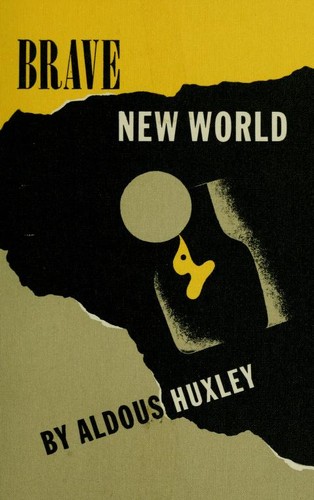
Brave New World
Aldous Huxley (1932)
“A world where everyone is happy, no one suffers, and something irreplaceable has been destroyed.”
Brave New World— Summary & Analysis
by Aldous Huxley · published 1932 · 311 pages · Modernist / Dystopian
A user-friendly study guide for Brave New World by Aldous Huxley (1932): a high-level plot summary, full chapter-by-chapter analysis, theme breakdowns, character profiles, and 30 essay questions designed for high-school, ap-english, college readers. Unlike a stock summary, sumsumsum.com adds a diction analysis drawn from Aldous Huxley’s actual text, the 9 documented AP Literature exam appearances of this book, and reading-difficulty guidance (Easy, 3/10) so students, teachers, and lifelong readers know what they are walking into.
“A world where everyone is happy, no one suffers, and something irreplaceable has been destroyed.”
Short Summary
In the World State of 632 A.F. (After Ford), human beings are manufactured in hatcheries, conditioned from birth, and kept pacified with the pleasure drug soma. Bernard Marx, an Alpha intellectual who feels like an outsider, takes the pneumatic Lenina Crowne to a Savage Reservation in New Mexico, where they discover John — the son of a World State woman, raised on Shakespeare. John is brought back to civilization as a curiosity, but he's horrified by its shallow hedonism. When he rebels, demanding the right to be unhappy, the World Controller Mustapha Mond explains why the choice was made: stability required the sacrifice of art, science, religion, and authentic emotion. John retreats to a lighthouse to live as an ascetic and is eventually destroyed by the world's voyeuristic hunger for his suffering.
Detailed Summary
The World State in 632 A.F. (After Ford — Ford as deity, his assembly line as sacred model) operates on three foundational pillars: biological engineering, psychological conditioning, and unlimited consumption. Humans are decanted in bottles at the Central London Hatchery and Conditioning Centre. Th...
Summary in the Author’s Writing Style
A retelling of Brave New World in Aldous Huxley’s style — so you can hear the language, not just the plot. This is a stylistic pastiche written by sumsumsum, not an excerpt from the book.
In the year 632 After Ford, the Central London Hatchery and Conditioning Centre performed its small daily miracles of subtraction. Here, in the pale refrigerated light, the egg was fertilized, bottled, decanted; the Bokanovsky Process applied its budding division so that from a single ovum ninety-si…
Chapter-by-Chapter Analysis
If you liked Brave New World, read next
Start with Nineteen Eighty-Four by George Orwell — The essential companion — pain vs. pleasure as control, surveillance vs. conditioning, the same warning delivered through opposite methods. Then try We by Yevgeny Zamyatin — The 1921 Russian novel that both Huxley and Orwell drew from — the first great dystopia, almost unknown in the West. Or pivot to The Giver by Lois Lowry — Young adult version of Huxley's core argument — a community that abolished suffering by abolishing choice, and one person who discovers the cost.
For comparative essays, pair Brave New World with
The strongest comparative pairing is The Handmaid's Tale (Margaret Atwood) — Completes the dystopian triangle — Huxley's pleasure, Orwell's surveillance, Atwood's religious patriarchy, all warning about social stability purchased through oppression.
Each of these pairings opens a clean thesis path on shared themes, period diction, or formal influence — useful for AP Lit / IB / first-year college comparative essays.
More from Aldous Huxley and the scholars who study Huxley
The standard scholarly entry points to Aldous Huxley’s work: Nicholas Murray (Welsh literary biographer) — Aldous Huxley: An English Intellectual (2002). These are the works graduate seminars cite when teaching Aldous Huxley.