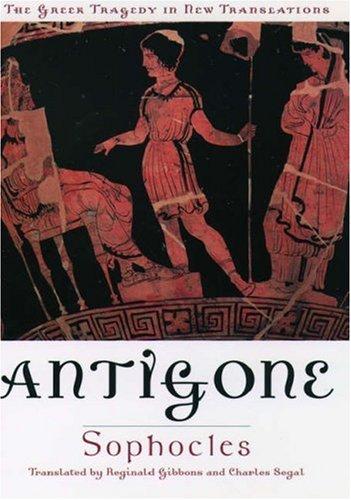
Antigone
Sophocles (-441)
“A young woman defies the state to bury her brother. The state's king breaks her. Both destroy each other — and the tragedy belongs equally to both.”
Antigone— Historical Context & Author Background
Author: Sophocles · Published -441· Era: Classical Antiquity·60 pages
Themes explored: justice, duty, law, family, gender, pride, fate, civil-disobedience
About Sophocles
Sophocles (c. 496–406 BCE) was an Athenian tragedian who wrote approximately 123 plays, of which seven survive complete. He was a public figure as well as a playwright — he held civic office and served as a military general under Pericles. His life encompassed the height of Athenian democracy, the Persian Wars, the building of the Parthenon, and the beginning of the Peloponnesian War. He competed in the dramatic festivals at the City Dionysia and won first prize approximately 18 times — never finishing lower than second. He died at roughly 90, the year the Peloponnesian War was turning decisively against Athens.
Life → Text Connections
How Sophocles's real experiences shaped specific elements of Antigone.
Sophocles lived through the full flowering and early crisis of Athenian democracy under Pericles
The tension between Creon's one-man rule and the Chorus's democratic voice — the Chorus represents the citizenry that Athenian democracy was supposed to empower
The play is partly a meditation on what happens when democratic consensus-building fails and a single voice seizes all authority. Creon is a warning about the tyranny that democracy must resist.
Sophocles served as general and civic official — he understood political power from the inside
Creon's political reasoning is sophisticated and not simply villainous — Sophocles gives him the arguments a competent ruler would use
A playwright with no civic experience might have made Creon a cartoon tyrant. Sophocles makes him comprehensible, which makes the tragedy deeper.
Greek tragedy was performed at the City Dionysia — a civic religious festival, not merely entertainment
The play's central conflict between divine law and human decree was a live political question in Athens, not an abstract philosophical exercise
Every Athenian citizen in the audience was simultaneously a voter in the democracy and a subject of divine law. The play spoke directly to how they lived.
Historical Era
Classical Athens, circa 441 BCE — age of Pericles, height of Athenian democracy and empire
How the Era Shapes the Book
The play enters a live Athenian debate about the relationship between religious obligation and civic law. Athens had just created a system in which human deliberation — the Assembly — could override old custom. But the religious traditions that pre-dated the city-state still held enormous authority. Creon's decree that civic law supersedes all was recognizable as a contemporary political position; Antigone's counter that divine law can never be overridden was equally recognizable as a traditional religious claim. The audience was not watching a settled question — they were watching their own political arguments acted out to their fatal conclusions.
Why Antigone Matters Historically
Antigone is the earliest surviving dramatization of the conflict between individual conscience and state authority — a conflict that has recurred in every subsequent political era. It has been performed in resistance to Nazi occupation, apartheid, military dictatorship, and colonial rule. Hegel used it as the paradigm case of tragic conflict between two equally valid ethical systems. It may be the most politically generative play ever written.
- First dramatization of civil disobedience as a philosophical and dramatic subject
- One of the earliest works to give a female character a sustained political argument against male authority
- Pioneered the dramatic structure of two protagonists who are both right and both wrong — what Hegel called 'the collision of right with right'
Performed against official prohibition in apartheid South Africa, under military junta in Greece (1967-1974), and during Nazi occupation of France. The play has been more frequently censored or performed in defiance of censorship than any other work of classical antiquity — which confirms that its political content reads as live and threatening, not merely historical.