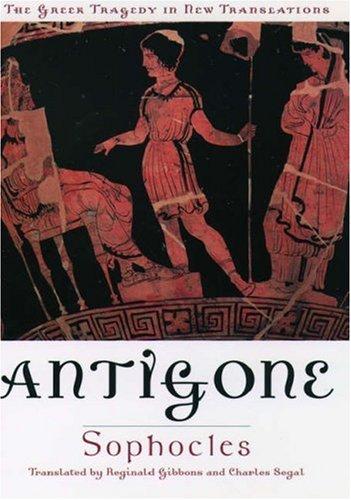
Antigone
Sophocles (-441)
“A young woman defies the state to bury her brother. The state's king breaks her. Both destroy each other — and the tragedy belongs equally to both.”
Language Register
Highly formal verse throughout — Greek tragic trimeter in dialogue, lyric meters in choral odes — translated into elevated English prose or blank verse depending on edition
Syntax Profile
Dialogue in stichomythia — rapid single-line exchanges — especially during confrontations. Creon's speeches are long, logically structured, politically confident. Antigone's major speech is a formal philosophical argument built on paired contrasts (your law vs. divine law, mortal decree vs. eternal norm). Haemon's speeches are carefully hedged diplomatic arguments. The Chorus speaks in longer lyric stanzas that move by image and association rather than logical sequence.
Figurative Language
Moderate — Sophocles is sparer than his predecessor Aeschylus. Images of animals (the eagle, birds carrying pollution), the ship of state, the bending tree, the locked tomb as bridal chamber. Political power is consistently figured as navigation and steering — Creon's authority is a vessel, and vessels can capsize.
Era-Specific Language
Ritual pollution from contact with death or impiety — a physical-theological contamination that can infect a city
Human law, custom, convention — the written decrees of rulers and the unwritten norms of the city
Natural law, the order embedded in nature and the divine — Antigone's appeal against Creon's nomos
Overweening pride that offends the gods — primarily Creon's offense, not Antigone's, in Sophocles's construction
The two movements of a choral ode, sung as the Chorus moves left then right — the formal architecture of Greek lyric argument
How Characters Speak — Class & Identity
Antigone
Formal, unhedged, direct address to Creon without honorifics once the confrontation begins. Defiant rhetoric that refuses to soften claims or qualify assertions.
Royal birth gives her standing to address the king as an equal — but it also marks her awareness that this standing is what makes her defiance legible as political rather than merely criminal.
Creon
Political language — 'the state,' 'the city,' 'my decrees.' Pivots to gender language when challenged by women. Accuses opponents of being 'bribed' whenever their arguments are strong.
The language of civic authority deployed to cover the language of personal insecurity. Creon's political register is a rhetorical armor that cracks under pressure.
Haemon
Diplomatic — begins with flattery, proceeds to evidence, ends with metaphor. Uses third-person to report public opinion rather than stating his own view directly until forced.
A man who understands power and knows how to navigate it — which makes his failure to change Creon's mind all the more damning. Even perfect diplomatic skill cannot fix a ruler who will not hear.
Ismene
Practical, hedged, probabilistic — 'we cannot,' 'it is impossible,' 'women must.' Language oriented toward survival and calculation.
Ismene speaks the language of women who have learned to operate within constraint. Her later offer to share guilt shifts to the language of love — but Antigone will not let her trade registers.
Tiresias
Oracular — declarative, non-negotiable, image-heavy. Does not argue; announces. Uses the vocabulary of pollution, sacrifice, and divine exchange.
The prophet's register is the only one in the play that Creon cannot dismiss with accusations of self-interest — and yet he tries. The accusation of bribery against Tiresias marks Creon's final failure of judgment.
the Chorus
Modulated civic voice — supportive of authority in early scenes, increasingly troubled, finally honest only after Creon has been broken. Speaks in generalizations and mythic comparisons rather than direct critique.
The Chorus is the democratic voice of Athenian civic life — prudent, collective, slow to anger, unwilling to confront power directly until it becomes undeniable. In Pericles's Athens, this was both a virtue and a form of complicity.
Narrator's Voice
There is no single narrator — this is drama. The Chorus serves the narrator function, mediating between the audience and the action, providing retrospective context and moral commentary. The Chorus is simultaneously a character (Theban elders) and a voice of communal wisdom — and the gap between these functions, when the elders fail to tell Creon the truth until it is too late, is part of the play's political critique.
Tone Progression
Prologue – Episode 1
Defiant, declarative, politically charged
Antigone is decisive; Creon is confident. Both speak with authority. The collision of two certainties.
Episodes 2-3
Confrontational, increasingly personal
The philosophical debate surfaces deeper power dynamics — gender, family, civic authority. Creon's language becomes more personal, less political.
Episodes 4-5
Elegiac, prophetic, doom-laden
Antigone mourns. Tiresias prophesies. The Chorus's odes grow darker. The inevitability settles in.
Exodus
Catastrophic, fragmented, desolate
Creon's language collapses. The stage fills with bodies. Wisdom arrives, stripped of all use.
Stylistic Comparisons
- Aeschylus — Sophocles is more spare and character-driven; Aeschylus uses more elaborate imagery and divine machinery
- Shakespeare's history plays — both investigate the collision between personal conscience and political authority
- Brecht's Antigone adaptation (1948) — strips the play to its political skeleton to comment on Nazism, removing the gods entirely
Key Vocabulary from This Book
Notable words used in this text — click to see full definitions