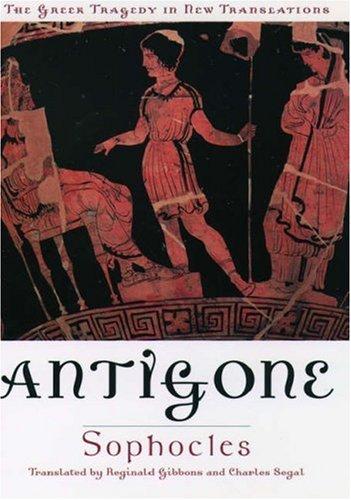
Antigone
Sophocles (-441)
“A young woman defies the state to bury her brother. The state's king breaks her. Both destroy each other — and the tragedy belongs equally to both.”
Antigone— Summary & Analysis
by Sophocles · published -441 · 60 pages · Classical Antiquity
A user-friendly study guide for Antigone by Sophocles (-441): a high-level plot summary, full chapter-by-chapter analysis, theme breakdowns, character profiles, and 30 essay questions designed for high-school, ap-english, college, ib readers. Unlike a stock summary, sumsumsum.com adds a diction analysis drawn from Sophocles’s actual text, the 9 documented AP Literature exam appearances of this book, and reading-difficulty guidance (Easy, 3/10) so students, teachers, and lifelong readers know what they are walking into.
“A young woman defies the state to bury her brother. The state's king breaks her. Both destroy each other — and the tragedy belongs equally to both.”
Short Summary
After the civil war that kills both sons of Oedipus, the new king Creon decrees that the rebel son Polynices must rot unburied. Antigone, the brothers' sister, defies the decree and covers the body. Creon sentences her to death. The prophet Tiresias warns that the gods are offended. Creon relents too late — Antigone has hanged herself, Creon's son Haemon (who loved Antigone) kills himself over her body, and Creon's wife Eurydice kills herself on learning of Haemon's death. Creon survives as a broken man who destroyed everything he ruled over.
Detailed Summary
The play opens outside the palace of Thebes immediately after the civil war in which Eteocles and Polynices — the two sons of Oedipus — have killed each other. Eteocles defended the city; Polynices attacked it. Creon, who has just assumed rule as the next senior male, has given Eteocles a hero's bur...
Summary in the Author’s Writing Style
A retelling of Antigone in Sophocles’s style — so you can hear the language, not just the plot. This is a stylistic pastiche written by sumsumsum, not an excerpt from the book.
Sing, elders of Thebes, of the house that the gods have not yet finished breaking. The seven gates stand open. The dust of war has scarcely settled, and already two brothers lie in the field where they fell upon each other — Eteocles who held the wall, Polynices who broke himself against it — and th…
Chapter-by-Chapter Analysis
If you liked Antigone, read next
Start with A Man for All Seasons by Robert Bolt — Thomas More's refusal to validate Henry VIII's divorce mirrors Antigone's structure exactly — a principled individual against absolute state authority, dying for a law the state doesn't recognize. Then try Henry V by William Shakespeare — Creon's position — the king whose authority must be absolute for the city to function — finds its most articulate English defence in Henry V's arguments about obedience and kingship. Or pivot to Letter from Birmingham Jail by Martin Luther King Jr. — King's argument that unjust laws have no moral authority — and that the individual has not only the right but the duty to disobey them — is the same argument Antigone makes to Creon across 2,500 years.
For comparative essays, pair Antigone with
The strongest comparative pairing is The Crucible (Arthur Miller) — Another drama about individual conscience against institutional authority — Miller explicitly modeled John Proctor's death on Antigone's logic: some things are worth dying for. For a third angle, contrast with Medea (Euripides) — The other great Greek female protagonist who defies the social order — where Antigone acts from principle, Medea acts from passion; both terrify audiences for different reasons.
Each of these pairings opens a clean thesis path on shared themes, period diction, or formal influence — useful for AP Lit / IB / first-year college comparative essays.
More from Sophocles and the scholars who study Sophocles
Other works by Sophocles: Oedipus Rex (-429, 75 pages). Reading two or three of these in sequence reveals Sophocles’s recurring obsessions and stylistic signatures more clearly than any single book can.
The standard scholarly entry points to Sophocles’s work: Bernard Knox (Yale, Director of Center for Hellenic Studies) — The Heroic Temper (1964); Charles Segal (Harvard, Walter C. Klein Professor) — Tragedy and Civilization: An Interpretation of Sophocles (1981). These are the works graduate seminars cite when teaching Sophocles.