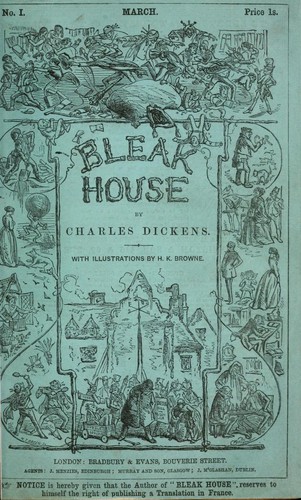
Bleak House
Charles Dickens (1853)
“A fog-bound masterpiece that invented the detective novel, condemned an entire legal system, and proved that institutions can kill as surely as any murderer.”
This page prints on a single page. Use Ctrl+P / Cmd+P.
Bleak House
Charles Dickens (1853) · 950pages · Victorian · 5 AP appearances
Summary
The interminable Chancery Court case of Jarndyce and Jarndyce devours everyone it touches. Esther Summerson, an orphan raised in shame, becomes ward of the benevolent John Jarndyce alongside cousins Richard Carstone and Ada Clare. As Richard spirals into obsession with the lawsuit, a parallel mystery unfolds: Lady Dedlock, wife of an aristocrat, harbors a secret connection to Esther. The lawyer Tulkinghorn investigates, is murdered, and Inspector Bucket — one of fiction's first detectives — unravels the threads. The case finally resolves when the entire estate has been consumed in legal costs, Richard dies broken, and Esther discovers her true identity while building a quiet, honest life outside the system that destroyed so many.
Why It Matters
Bleak House is widely considered Dickens' masterpiece and one of the greatest novels in the English language. It pioneered the detective plot in serious fiction (Inspector Bucket predates Sherlock Holmes by thirty-five years), invented the dual narration technique that later writers from Faulkner...
Themes & Motifs
Diction & Style
Register: High formal in the omniscient narrator (Latinate, periodic sentences, parliamentary irony); conversational-intimate in Esther's narration (self-deprecating, domestic, restrained). Dialect ranges from aristocratic precision to Jo's illiterate phonetic speech.
Narrator: Dual narration — the novel's most revolutionary feature. The unnamed omniscient narrator speaks in the present tense ...
Figurative Language: Extremely high
Historical Context
1850s England — industrialization, sanitary crisis, legal reform debates, the Great Exhibition: Bleak House was a direct intervention in 1850s reform debates. The Chancery critique was so specific and so public that it contributed to the eventual Judicature Acts of 1873-75, which abolished th...
Key Characters
Talking Points
- Why does Dickens use two narrators with completely different styles — an omniscient present-tense voice and Esther's past-tense first person? What can each voice do that the other cannot?
- The novel opens with fog. How does this fog function as more than atmosphere? Trace the fog metaphor through the entire novel.
- Is Richard Carstone's destruction his own fault? Or does the novel argue that any reasonable person in his position might have made the same choices?
- Jo is told to 'move on' throughout the novel but is never told where to move to. What is Dickens saying about Victorian England's treatment of the poor?
- Lady Dedlock calls herself 'wicked.' Is she? What has she actually done wrong, and whose moral framework judges her?
Notable Quotes
“Fog everywhere. Fog up the river, where it flows among green aits and meadows; fog down the river, where it rolls defiled among the tiers of shipping.”
“It would have been far better, little Esther, that you had had no birthday; that you had never been born.”
“The one great principle of the English law is, to make business for itself.”
Why Read This
Because every institution you will deal with — courts, governments, bureaucracies, universities — operates by the same logic Dickens dissected in 1853. Chancery is the DMV, the health insurance appeal, the student loan system. The fog is still eve...