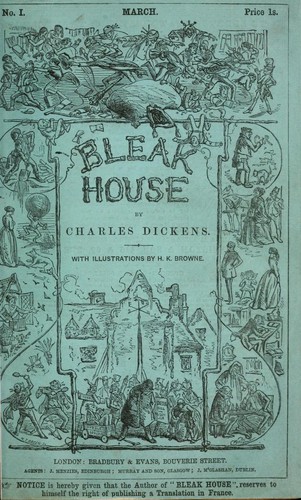
Bleak House
Charles Dickens (1853)
“A fog-bound masterpiece that invented the detective novel, condemned an entire legal system, and proved that institutions can kill as surely as any murderer.”
Essay Questions & Food for Thought
30questions designed to challenge assumptions and provoke original thinking. These can't be answered from a summary — you need the actual text.
Why does Dickens use two narrators with completely different styles — an omniscient present-tense voice and Esther's past-tense first person? What can each voice do that the other cannot?
The novel opens with fog. How does this fog function as more than atmosphere? Trace the fog metaphor through the entire novel.
Is Richard Carstone's destruction his own fault? Or does the novel argue that any reasonable person in his position might have made the same choices?
Jo is told to 'move on' throughout the novel but is never told where to move to. What is Dickens saying about Victorian England's treatment of the poor?
Lady Dedlock calls herself 'wicked.' Is she? What has she actually done wrong, and whose moral framework judges her?
The spontaneous combustion of Krook was attacked by critics as scientifically impossible. Why did Dickens insist on keeping it? What symbolic work does this scene perform?
Inspector Bucket is one of the first literary detectives. How does he differ from later detectives like Sherlock Holmes? What does his method reveal about Dickens' view of how truth is discovered?
Compare Esther's narration to the omniscient narrator's voice. Read a passage from each aloud. How do the rhythms, sentence structures, and word choices differ? Why?
Smallpox travels from Jo to Charley to Esther, crossing every class boundary in the novel. What argument is Dickens making about the relationship between poverty and public health?
Harold Skimpole claims to be 'a mere child.' How does his performed innocence function as a form of exploitation? Is he more or less harmful than an open villain like Tulkinghorn?
Mrs. Jellyby practices 'telescopic philanthropy' — caring about Africa while her own children suffer. What is Dickens' critique of Victorian charity, and is it still relevant?
Sir Leicester Dedlock is mocked for hundreds of pages as pompous and absurd. Then he forgives Lady Dedlock unconditionally. Why does Dickens give this character his most emotionally powerful moment?
Miss Flite keeps caged birds named Hope, Joy, Youth, Peace, and Dust. She releases them when the Jarndyce case ends. Why is this moment devastating rather than triumphant?
Tulkinghorn's motives are deliberately left ambiguous. He does not want money or advancement. What does he want? Why does Dickens refuse to explain him fully?
How does Bleak House function as a 'condition of England' novel? What specific reforms was Dickens advocating, and did the novel actually contribute to change?
The case of Jarndyce and Jarndyce ends when the costs absorb the entire estate. Is this a satisfying ending? What does Dickens gain by making the resolution an anticlimax?
Esther's face is scarred by smallpox. How does this physical change affect her self-worth, and what does this reveal about Victorian attitudes toward women?
Compare Bleak House's critique of bureaucracy to Kafka's The Trial. Both feature individuals destroyed by systems they cannot understand. What are the key differences?
Dickens published Bleak House in twenty monthly installments. How does serial publication shape the novel's structure — its cliffhangers, its parallel plots, its pacing?
What modern institutions function like Chancery — consuming more resources than they deliver, existing primarily to perpetuate themselves? Is Dickens' critique still useful?
Dickens modeled Harold Skimpole partly on the real poet Leigh Hunt. Was this fair? Does knowing the real-life model change how you read the character?
The novel contains both a murder mystery and a social satire. How do these genres interact? Does the detective plot distract from or reinforce the institutional critique?
Esther ends the novel unable to finish a sentence about whether her face has recovered its beauty. Why does Dickens leave this question unresolved?
Jo's death scene was one of the most widely read passages in Victorian England. Modern readers often find it too sentimental. Is the sentimentality a weakness or a deliberate strategy?
Compare Vholes to a modern professional who profits from others' misfortune — a debt collector, a payday lender, a for-profit college recruiter. Is Dickens' portrait of professional parasitism still accurate?
The Ghost's Walk at Chesney Wold — a legend of ghostly footsteps when the Dedlock family faces disgrace — runs through the novel. What does this Gothic element add to a work of social realism?
Dickens testified before a parliamentary commission on Chancery reform. How does knowing this change your reading of Bleak House? Is the novel art, journalism, or testimony?
Lady Dedlock dies at the gate of the pauper's cemetery where Captain Hawdon is buried. She has exchanged her aristocratic clothes for a poor woman's dress. What does this final image mean?
Why does Dickens make Esther — not the omniscient narrator — the one who finds Lady Dedlock's body? What is gained by filtering this moment through Esther's restrained voice?
Bleak House is 950 pages long. Could it be shorter? What would be lost if Dickens cut the Jellyby subplot, the Turveydrop subplot, the Skimpole subplot? Are these 'digressions' or essential structure?