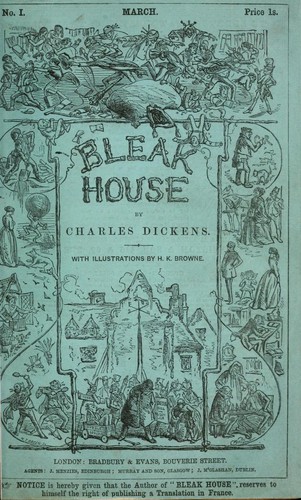
Bleak House
Charles Dickens (1853)
“A fog-bound masterpiece that invented the detective novel, condemned an entire legal system, and proved that institutions can kill as surely as any murderer.”
For Students
Because every institution you will deal with — courts, governments, bureaucracies, universities — operates by the same logic Dickens dissected in 1853. Chancery is the DMV, the health insurance appeal, the student loan system. The fog is still everywhere. And the dual narration is Dickens doing something no novelist had done before — giving you two entirely different ways of seeing the same world in a single book. It is also, despite its reputation, frequently very funny.
For Teachers
The dual narration alone supports an entire unit on narrative technique — no other novel offers such a clean comparison of omniscient vs. first-person voice within the same text. The detective plot provides entry points for students who resist Victorian fiction. The institutional critique connects directly to contemporary discussions of systemic injustice. And the diction analysis is inexhaustible: every character speaks a different English, and each register reveals a class position.
Why It Still Matters
Any system that exists primarily to perpetuate itself — any bureaucracy that costs more to maintain than it delivers, any institution that destroys the people it claims to serve — is Chancery. The novel is an argument that fog is not natural weather but manufactured obscurity, and that the first step toward justice is seeing clearly. That argument has not aged.