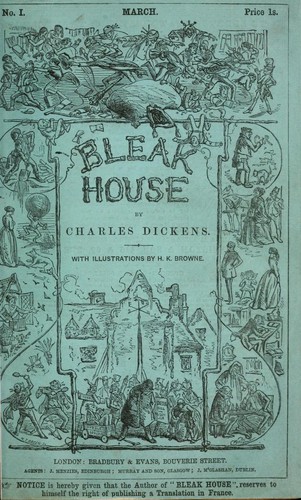
Bleak House
Charles Dickens (1853)
“A fog-bound masterpiece that invented the detective novel, condemned an entire legal system, and proved that institutions can kill as surely as any murderer.”
Language Register
High formal in the omniscient narrator (Latinate, periodic sentences, parliamentary irony); conversational-intimate in Esther's narration (self-deprecating, domestic, restrained). Dialect ranges from aristocratic precision to Jo's illiterate phonetic speech.
Syntax Profile
The omniscient narrator uses long, architecturally complex periodic sentences — subordinate clause upon subordinate clause, building to a satirical point that lands like a verdict. Esther's sentences are shorter, parenthetical, full of qualifications and self-corrections ('I don't know how to put it — I am not clever enough'). Jo speaks in fragments and phonetic dialect. Tulkinghorn speaks in complete, clipped, legally precise sentences. Bucket speaks in colloquial loops that disguise razor-sharp logic. The novel contains more distinct registers than any other work in English fiction.
Figurative Language
Extremely high — dominated by extended metaphor (fog = Chancery, disease = social interconnection, birds = freedom deferred) rather than isolated similes. Dickens builds metaphors across hundreds of pages: the fog of Chapter 1 is still clearing in Chapter 67. Personification is constant — Chancery 'has its decaying houses and its blighted lands,' as if the institution were a living parasite.
Era-Specific Language
Court of Equity handling wills, trusts, and property — notoriously slow and expensive in the 1850s
A person (often a child) who swept horse dung from street crossings for tips — one of the lowest occupations
Dickens' coinage for charity directed at distant causes while ignoring local suffering
Pseudo-scientific belief that alcoholics could ignite from within — Dickens defended this as fact
Jarndyce's euphemism for any topic connected to the lawsuit or to suffering he cannot fix
Police directive to homeless and vagrants — Jo hears it constantly, a refrain of institutional cruelty
How Characters Speak — Class & Identity
Esther Summerson
Self-deprecating, domestic, habitually modest. Avoids first-person assertions. 'I am not clever' is her refrain.
A woman raised in shame who has learned that visibility is dangerous. Her modesty is survival strategy, not nature.
Lady Dedlock
Cold, measured, aristocratically detached. Short, declarative sentences. 'I am your wicked and unhappy mother' — precision even in confession.
Aristocratic composure as armor. Lady Dedlock speaks the language of power even when that power has destroyed her.
Sir Leicester Dedlock
Pompous, periodic, self-important. Refers to himself in the third person. Formal even in emotional extremity.
Old aristocracy performing its own importance. But Dickens grants him genuine dignity in crisis — the pomposity conceals real feeling.
Jo
Phonetic dialect — 'wos,' 'nothink,' 'yer.' Cannot form complete sentences. Cannot take an oath because he has never heard of God.
Total exclusion from every institution. Jo's language is the sound of a person the system has decided does not exist.
Harold Skimpole
Elaborate, aestheticized, full of artistic metaphor. Speaks of money as if it were an abstraction that does not apply to him.
The weaponization of charm. Skimpole's refined language is a machine for extracting value from others while claiming innocence.
Inspector Bucket
Colloquial, friendly, repetitive. 'I don't put a finer point upon it.' Verbal warmth that disguises investigative precision.
Professional middle-class competence. Bucket speaks the language of the people he investigates, adapting his register to match his audience.
Mr. Tulkinghorn
Clipped, precise, legally exact. Never says more than necessary. Silence is his primary weapon.
Power through information control. Tulkinghorn's sparse language reflects a man who understands that knowledge withheld is power accumulated.
Richard Carstone
Enthusiastic and articulate early; fragmented, defensive, and paranoid late. His deterioration tracks in his speech.
The corruption of potential by false hope. Richard's language degrades as the lawsuit consumes him — form mirrors psychological destruction.
Narrator's Voice
Dual narration — the novel's most revolutionary feature. The unnamed omniscient narrator speaks in the present tense with corrosive irony, surveying all of England as a connected system of exploitation. Esther Summerson narrates in the past tense, first person, with domestic warmth and compulsive self-deprecation. The two voices never directly acknowledge each other. The reader must hold both perspectives simultaneously — the systemic and the personal, the satirical and the sympathetic — and the tension between them IS the novel's meaning.
Tone Progression
Chapters 1-14
Satirical, expansive, comic
The fog of Chancery established. Dickens surveys his enormous cast with savage wit. Esther's voice is hopeful and tentative.
Chapters 15-39
Darkening, investigative, claustrophobic
Secrets and disease tighten their grip. The smallpox crosses class lines. Tulkinghorn closes in. Richard deteriorates. The comedy turns bitter.
Chapters 40-53
Urgent, tragic, propulsive
Murder, pursuit, and revelation. The detective plot drives the pace. Lady Dedlock's flight and death. The novel's most emotionally intense chapters.
Chapters 54-67
Elegiac, resigned, quietly devastating
The Jarndyce case collapses into nothing. Richard dies. Esther finds domestic peace. The system continues unchanged. Rain falls on Chesney Wold.
Stylistic Comparisons
- Thackeray's Vanity Fair — similarly panoramic social satire, but Thackeray is cooler, more detached; Dickens is angrier and more sentimental simultaneously
- George Eliot's Middlemarch — equally complex social web, but Eliot's narrator is philosophical where Dickens' is polemical
- Wilkie Collins' The Woman in White — Collins learned the detective plot from Bleak House and streamlined it into pure sensation fiction
- Kafka's The Trial — the Chancery labyrinth anticipates Kafka's bureaucratic nightmare by sixty years, but Dickens still believes in human resistance
Key Vocabulary from This Book
Notable words used in this text — click to see full definitions